
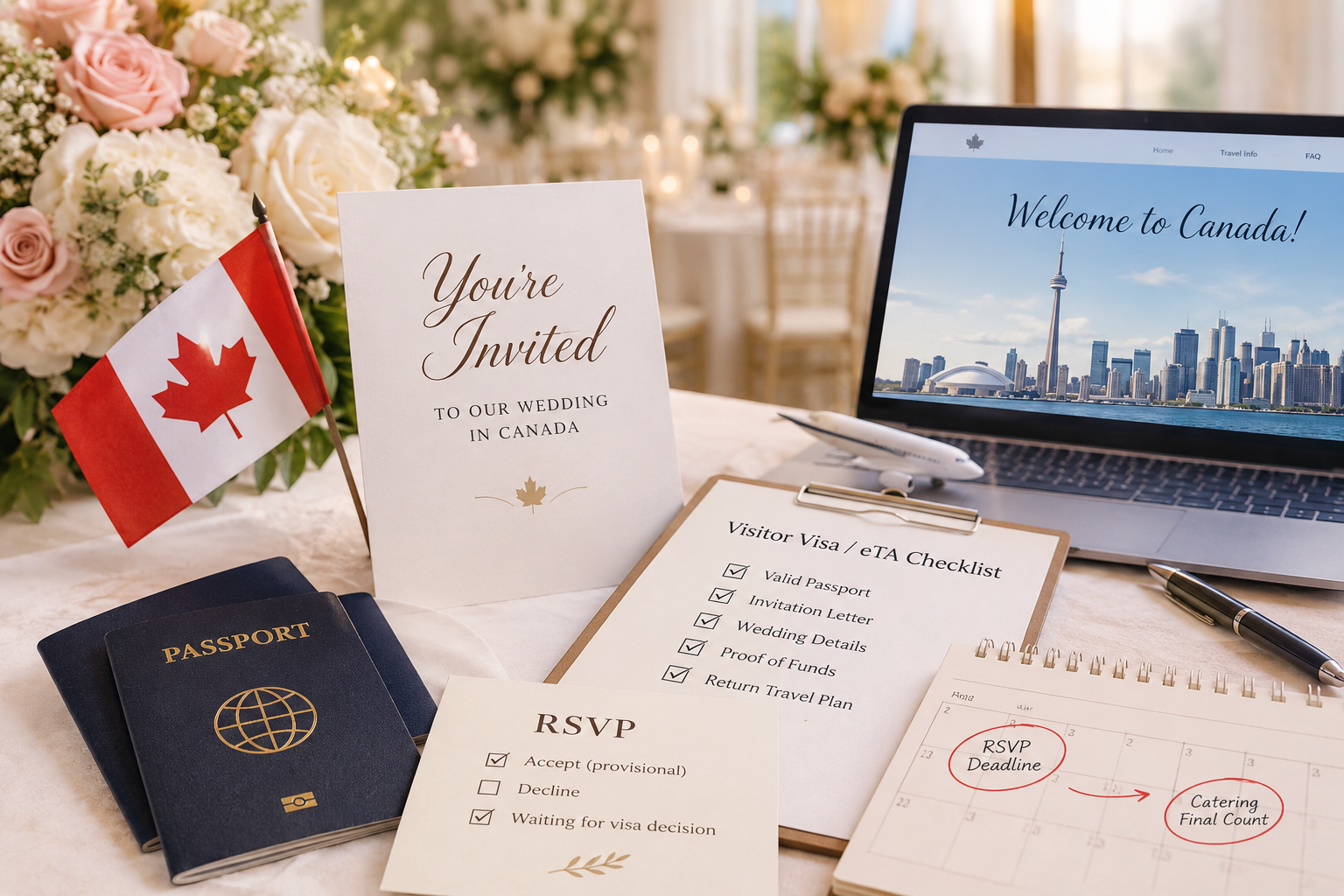
Inviting relatives and friends from abroad can make your wedding feel even more meaningful. It can also add an extra layer of planning when some guests need permission to travel to Canada.
A guest may need a Canadian visitor visa, an electronic travel authorization, commonly called an eTA, or simply a valid passport. The correct document depends on factors such as the guest’s nationality, passport, immigration status and method of travel.
At the same time, your venue and caterer will still expect confirmed numbers by a fixed date. That means you need a plan for guests who genuinely want to attend but are still waiting for their travel documents.
This guide explains how Canadian couples can invite overseas wedding guests, prepare a useful invitation letter and manage RSVPs without treating every pending visa application as either a definite yes or a definite no.
Information reviewed in July 2026.
First, determine whether the guest needs a visitor visa or an eTA
Do not assume that every international guest needs the same document.
The Government of Canada recommends using its official visa and eTA eligibility checker. The answer can depend on:
The country that issued the guest’s passport
The guest’s nationality
The type of passport or travel document being used
Whether the guest is arriving by air, land or sea
Whether the guest already has a valid Canadian visa
In some cases, whether the guest has held a Canadian visa or certain United States visas in the past
Everyone travelling to Canada needs the appropriate combination of travel document, visa, eTA or passport for their situation.
Visitor visa
A Canadian visitor visa, also known as a temporary resident visa, is placed inside the traveller’s passport. It allows the person to travel to a Canadian port of entry and request admission as a visitor.
Visitor visa processing times vary depending on the country from which the person applies and the circumstances of the application. Guests should check the current estimate using the official IRCC processing-times tool.
The displayed processing time is an estimate rather than a guaranteed decision date. A guest may also need to complete biometrics, respond to document requests and submit a passport before travelling.
Electronic travel authorization
An eTA is electronically connected to a traveller’s passport. It is generally used by visa-exempt foreign nationals travelling to Canada by air or transiting through a Canadian airport.
Visa-exempt travellers normally do not need an eTA when entering Canada by car, bus, train or boat. Some citizens of countries that normally require visas may also qualify for an eTA when flying to Canada, provided they meet specific conditions.
Most straightforward eTA applications are approved within minutes, but some take several days when additional documents are requested. An eTA can generally remain valid for up to five years or until the passport expires, whichever comes first.
Passport-only situations
Some travellers do not need either a visitor visa or an eTA. For example, United States citizens are generally exempt from the eTA requirement but still need proper identification, such as a valid U.S. passport.
Because exceptions can be very specific, send each overseas guest the official checker instead of trying to decide for them.
Contact overseas guests before regular invitations go out
Guests who may need visas should receive advance notice as soon as your wedding date and location are reasonably certain.
You do not have to wait until your printed invitation suite is finished. A private message or digital save-the-date can give them enough information to:
Confirm whether they need a visa or eTA
Check passport expiry dates
Review current processing times
Request time away from work
Begin collecting financial and employment documents
Estimate flight and accommodation costs
For guests who require visitor visas, nine to twelve months of advance notice can be useful. That is not an IRCC processing promise; it is simply a planning buffer for the application, biometrics, passport handling, travel arrangements and possible delays.
A simple early message could say:
We would love to have you with us for our wedding in [city, province] on [date]. Because you may need travel authorization to enter Canada, we wanted to share the details early. Please check the Government of Canada requirements for your passport before making travel plans. We can provide a formal invitation letter for your application.
What is a wedding invitation letter for a Canadian visitor visa?
A visitor visa invitation letter is written by someone in Canada and sent to the person applying for the visa. The guest includes it with their application when appropriate.
The letter helps establish a legitimate reason for the trip, but it does not guarantee that the visa will be approved. The immigration officer assesses the guest’s complete circumstances and application. Writing the letter also does not automatically make the couple legally responsible for the visitor after arrival.
The person writing the letter should be truthful and should only promise accommodation or financial assistance that they genuinely intend to provide.
What to include in a wedding invitation letter
According to IRCC, the letter should include the following information about the invited guest:
Full legal name
Date of birth
Current address and telephone number
Relationship to the person writing the letter
Purpose of the visit
Planned length of stay in Canada
Where the guest will stay
How the guest’s expenses will be paid
Planned departure date from Canada
The writer should also include:
Full legal name
Date of birth
Canadian address and telephone number
Job title
Canadian citizenship or permanent resident status, where applicable
A copy of a document proving Canadian status
Basic family details, including the names and birth dates of a spouse and dependants
These items come directly from the Government of Canada’s invitation-letter guidance.
For a wedding visit, the letter should also clearly identify:
Both partners’ names
Wedding date
Ceremony and reception location
Guest’s expected arrival and departure dates
Whether the guest will stay with the couple, another relative or at a hotel
Who will pay for flights, accommodation and daily expenses
Any related wedding events the guest will attend
Use the guest’s name exactly as it appears in their passport. Avoid vague language such as “They will visit sometime in the summer.”
Sample wedding invitation letter for a Canada visitor visa
Replace every bracketed section with accurate information.
Letter of invitation
[Your full legal name]
[Your complete Canadian address]
[Telephone number]
[Email address]
[Date]
To: Visa Officer
Immigration, Refugees and Citizenship Canada
Re: Invitation for [guest’s full legal name] to attend our wedding in Canada
Dear Visa Officer,
I am writing to invite [guest’s full legal name], born on [date of birth], currently residing at [complete address], to visit Canada from approximately [arrival date] to [departure date].
[Guest’s name] is my [relationship, such as aunt, uncle, cousin, sibling or friend]. The principal purpose of the visit is to attend my wedding to [partner’s full name] on [wedding date] at [venue name and complete address] in [city, province].
During the visit, [guest’s name] will stay at [complete accommodation address]. [Explain who will pay for accommodation, transportation, food and other expenses.] The guest plans to leave Canada on or before [departure date].
My full legal name is [name], and I was born on [date of birth]. I live at [Canadian address] and can be reached at [telephone number and email]. I work as a [job title] at [employer name]. I am a Canadian [citizen/permanent resident], and I have included a copy of [Canadian passport, citizenship document or permanent resident card] as proof of my status.
My immediate family consists of [spouse or partner’s name and date of birth, followed by dependants’ names and dates of birth, if applicable].
I have also included documents confirming our wedding date and venue. Please contact me if further information is required.
Sincerely,
[Signature]
[Full legal name]
Supporting wedding documents the couple can provide
The invitation letter should be consistent with the rest of the application. Couples may provide a small, organized supporting package containing:
A copy of the formal wedding invitation
Venue confirmation, ceremony confirmation or booking document
A wedding schedule showing the ceremony and reception
The wedding website address
Proof of the writer’s status in Canada
Accommodation details
A brief explanation of who is paying for the trip
Proof of the relationship, where it is relevant and available
You do not need to send an enormous wedding-planning file. Include documents that help verify the date, place, purpose and accommodation arrangements. Private financial terms in a venue contract can be redacted if they are unrelated to the guest’s application.
Documents the guest may need to provide
The couple’s invitation letter is only one part of the visitor visa application. IRCC states that an applicant generally must convince an officer that they:
Have a valid travel document
Have enough money for the visit
Will leave Canada at the end of the authorized stay
Have ties such as employment, a home, financial assets or family that will take them back to their country
Depending on the guest’s personalized document checklist, supporting evidence may include travel history, an itinerary, proof of accommodation, bank statements and an employment letter. IRCC’s application guidance notes that six months of bank account information may help demonstrate the applicant’s financial situation.
The guest—not the couple—must submit the application and remain responsible for its accuracy.
Avoid treating a pending visa as a confirmed RSVP
A guest may be fully committed to attending and still be unable to promise that they will receive permission to travel.
Instead of forcing them to select “attending” or “not attending,” track overseas guests using three practical stages:
Planning to attend — application pending
Travel approved — attendance confirmed
Unable to attend or application unsuccessful
This gives you a realistic headcount without pretending that a pending application is a guaranteed seat.
In MapleVow’s Canadian wedding RSVP system, you can keep guest information organized and follow up directly as deadlines approach.
Set two deadlines for guests waiting on visas
For overseas guests, one RSVP date is not always enough.
Provisional response deadline
Ask the guest to tell you whether they intend to attend, whether they have applied and whether they are still waiting for a decision.
This response helps you estimate your likely headcount without making it final.
Final confirmation deadline
Your final deadline should be based on the date when your venue or caterer requires guaranteed numbers.
Ask your venue:
When is the final guest count due?
Can the number increase after that date?
Can it decrease?
When are final meal selections required?
Can one or two places be held temporarily?
What happens if an international guest is approved late?
Do not choose your RSVP deadline solely by copying another wedding. Start with the contractual deadline and work backwards, leaving enough time to follow up with missing guests.
Suggested RSVP wording for guests with pending applications
You can add the following note to your wedding website or private guest message:
We understand that your attendance may depend on receiving permission to travel to Canada. Please submit a provisional response by [date] and select “visa or travel authorization pending.” If approved, please confirm your attendance no later than [final date], when we must provide our final numbers to the venue.
A warmer version could say:
We truly hope you can celebrate with us. We know international travel applications can take time, so please let us know whether you are planning to attend, even if your application is still pending. We will contact you again before our final catering deadline.
A practical timeline for inviting overseas wedding guests
Twelve months or more before the wedding
Identify guests who live outside Canada. Privately share the date and location and ask them to check which travel document they need.
Nine to twelve months before
Send personalized invitation letters to guests who are preparing visitor visa applications. Provide the wedding date, location and available supporting documents.
Six months before
Check whether applications have been submitted and whether guests have completed requested steps such as biometrics.
Three to four months before
Request a provisional RSVP. Confirm likely arrival dates, accommodation needs and whether the guest is still waiting for a decision.
Eight to ten weeks before
Review every pending international guest individually. Confirm your venue’s final headcount and meal-selection dates.
Four to six weeks before
Collect final responses where your vendor contract allows. Guests who still cannot confirm should understand that a place may no longer be guaranteed after the catering deadline.
After approval
Ask the guest to update their RSVP, confirm their passport details privately, finalize accommodation and review the wedding schedule. They should also travel with a copy of the invitation letter because a border services officer may ask to see it.
Should guests buy flights before receiving a visa?
A complete travel plan can help explain the purpose and length of the visit, and IRCC lists flight details and proof of accommodation as examples of itinerary evidence.
However, a pending application does not guarantee approval by a particular date. Guests can consider refundable reservations, flexible fares or proposed itineraries rather than making large non-refundable purchases too early.
For an eTA, the Government of Canada specifically recommends obtaining the authorization before booking a flight.
Frequently asked questions
Does a wedding invitation guarantee a Canadian visitor visa?
No. It confirms the purpose of the trip but does not guarantee approval. The officer assesses the guest’s complete application, finances, travel history, ties to their home country and intention to leave Canada after the visit.
Can the couple submit the visa application for the guest?
The guest is responsible for their application. Couples can provide the invitation letter, wedding documents and accurate information about accommodation or financial support.
Does the invitation letter have to be notarized?
IRCC’s general invitation-letter instructions do not state that every ordinary visitor invitation must be notarized. Guests should follow the personalized checklist and any instructions issued for their application.
Should every overseas guest receive the same letter?
Use a personalized letter for each individual guest or applying family. Names, dates, relationships, accommodation and financial arrangements should match the actual situation.
What happens if the visa is approved after the final catering deadline?
That depends on your venue contract. Ask in advance whether late additions are permitted. If not, tell pending guests clearly that their invitation remains sincere but attendance cannot be guaranteed after the final vendor deadline.
Keep the process organized and personal
Inviting overseas wedding guests requires more than mailing an invitation. Give them early notice, direct them to official Government of Canada information, prepare an accurate invitation letter and use a provisional RSVP status while their application is pending.
Most importantly, separate emotional intention from logistical confirmation. A guest can genuinely want to attend while still being unable to provide a final answer.
A clear system protects both sides: your guest receives enough time and useful documentation, while you retain an honest headcount for seating, meals and venue planning.
Use MapleVow to create your wedding website, collect online RSVPs and keep international and local guest information together. You can also read our guide to handling late wedding RSVPs in Canada and our complete guide to what to include on a Canadian wedding website.