
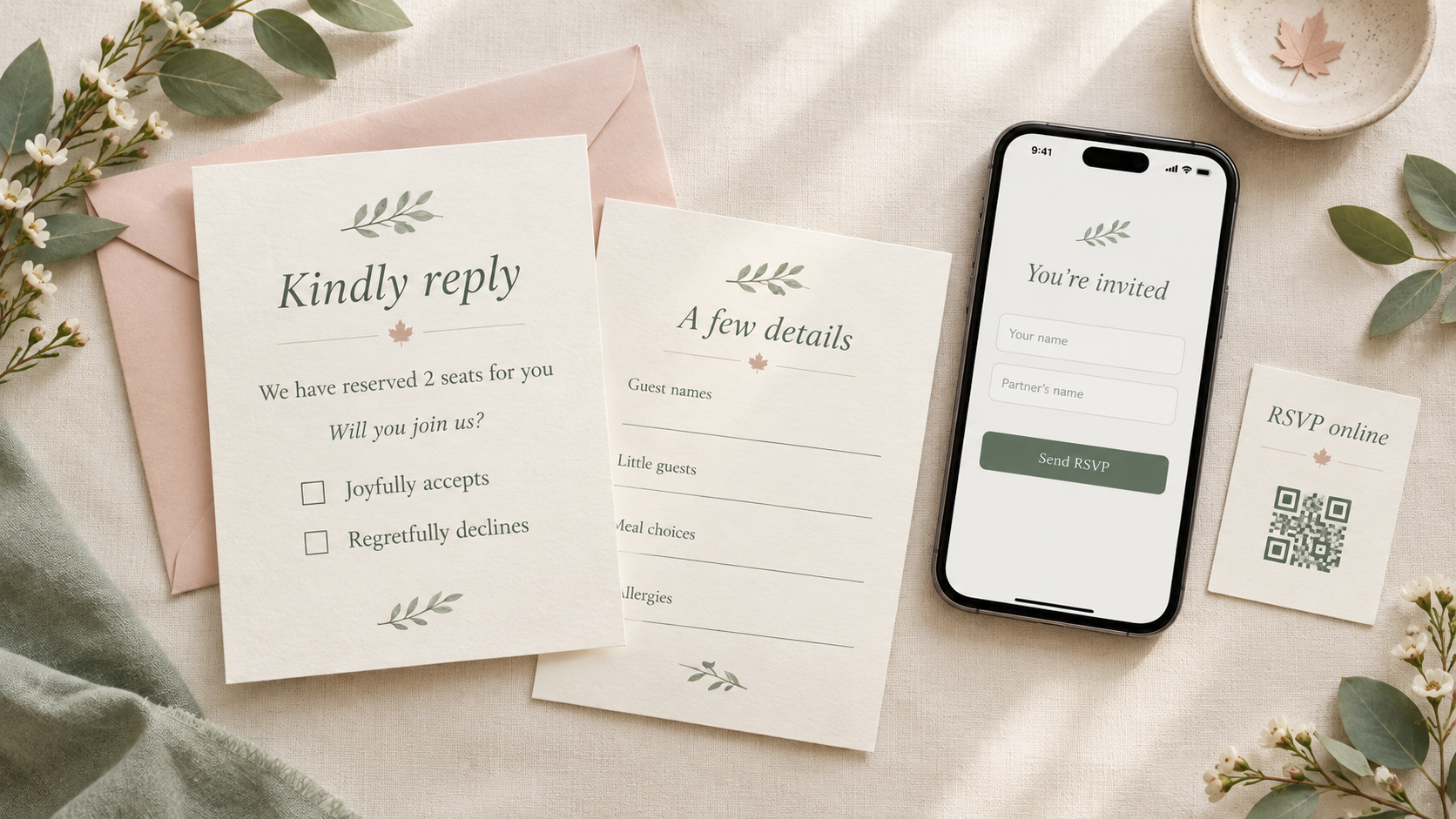
Wedding RSVP wording has one job that matters more than sounding clever: it should make it obvious what you need your guest to do.
That sounds simple until you need to fit attendance, a deadline, plus-ones, children, meal selections, dietary restrictions and perhaps several wedding events into one small card or screen.
The good news is that you do not need formal language unless it fits your wedding. Emily Post notes that an RSVP can be handled by response card, email, phone or other instructions provided by the host. Modern couples can keep the tradition of asking for a reply while choosing the response method that actually works for their guests.
Below are examples you can adapt for a Canadian wedding, whether you are using a printed reply card, a wedding website, a QR code or a guest-specific online RSVP.
The five things most RSVP wording needs to answer
Before choosing a tone, make sure the guest can answer these basic questions:
Who is invited?
Are they attending?
When must they reply?
How should they reply?
What extra information do you need if they attend?
Extra information may include a meal choice, dietary restrictions, an accompanying guest's name, children's attendance, shuttle needs or attendance at a brunch or welcome event.
If a sentence sounds elegant but leaves one of those points unclear, clarity wins.
Classic RSVP wording
For a traditional printed response card:
The favour of your reply is requested by September 1.
___ Joyfully accepts
___ Regretfully declines
Name(s): ____________________
A slightly more relaxed version:
Please RSVP by September 1.
___ Happily attending
___ Sorry to miss it
Name(s): ____________________
You do not need to use "M________" or force guests to fill in a title. MapleVow's inclusive RSVP wording guide recommends simply using the names guests actually use and asking direct, neutral questions.
Online wedding RSVP wording
When guests will respond on a website, keep the printed instruction short:
Please RSVP by September 1 at
maya-rowan.maplevow.ca/rsvp
Or:
Kindly reply by September 1.
RSVP online: maplevow.ca/s/maya-rowan
If you are using a QR code:
Please RSVP by September 1
Scan the QR code or visit maplevow.ca/s/maya-rowan
The backup URL matters. A QR code is convenient, but a short typed link gives guests another path if the code is damaged, too small, poorly printed or simply unfamiliar to them.
Plus-one wording when a guest is allowed to bring someone
Avoid vague wording such as "Are you bringing anyone?" because it can sound like the guest decides how many people are included.
Use a sentence that clearly states the invitation allowance:
Your invitation includes one guest. Will someone be joining you?
Then ask:
Guest's full name: ____________________
Or, in a warmer tone:
You are welcome to bring one guest. Please tell us who will be joining you.
This keeps the relationship neutral. A guest may bring a spouse, partner, sibling, friend or someone else. You do not need to label the relationship.
Wording when no plus-one is included
The cleanest solution is to identify invited people by name and configure the RSVP so only those people can respond.
If you need a written explanation, keep it polite and factual:
Due to the capacity of our venue, we are only able to accommodate the guests named on the invitation. Thank you for understanding.
Or:
We have reserved seats for the guests listed on your invitation.
Avoid making the message sound like a personal judgment about the guest's relationship. Capacity is easier to understand than a debate about who "deserves" a plus-one.
Wording for an adults-only wedding
A direct but warm version:
We love your little ones, but our wedding will be an adults-only celebration. We hope you can still join us.
If some children are invited and others are not, do not use a blanket adults-only statement. Instead, name the invited household members clearly and make the online RSVP show only the people included.
For example:
We have reserved 2 seats in your honour.
That can be especially useful when invitations go to households with different guest counts.
Wording when children are invited
If you need an exact count:
Which members of your household will be attending?
If you need children's ages for meals or seating:
If children will be joining you, please tell us their ages so we can plan seating and meals.
If you need high-chair information:
Will any attending child need a high chair?
___ Yes
___ No
Do not ask for information you will not use. Every extra field makes the RSVP feel longer.
Meal-choice wording
If each guest must choose an entrée, make the question individual rather than asking one household to provide a combined answer.
Please choose one entrée for each attending guest:
— Braised beef
— Atlantic salmon
— Wild mushroom risotto (vegetarian)
If the menu is not finalized:
Our venue will offer a meat, fish and vegetarian entrée. We will send final selections once the menu is confirmed.
For buffet or family-style service, you may not need an entrée question at all. Ask only for the information the caterer needs.
Dietary restriction and food-allergy wording
This is one place where vague wording is a bad idea.
Health Canada identifies a list of priority food allergens because some reactions can be severe. A generic "Any notes?" box makes important food-safety information easier to miss.
Use a specific question:
Do you have any food allergies or dietary restrictions we should share with our caterer?
Or:
Please list any food allergies, dietary restrictions or religious dietary needs for each attending guest.
If your venue has a formal allergy process, you can add:
For severe allergies, our venue may contact you for additional information before the wedding.
Do not promise that every request can be accommodated until the caterer confirms it. The RSVP should collect the information accurately; the venue determines what it can safely provide.
Accessibility wording
You can ask about practical needs without asking guests to disclose a diagnosis.
For example:
Is there anything we should know to make the day more accessible or comfortable for you? Examples may include step-free access, accessible seating, communication needs or a quieter space.
Or a shorter version:
Do you have any accessibility needs we should plan for? (Optional)
Keep this optional and focus on the accommodation you can act on.
Multi-event RSVP wording
Wedding weekends can become confusing if a guest sees one generic "Will you attend?" question but is invited to three separate events.
Use event-specific questions:
Welcome drinks — Friday at 8:00 p.m.
Will you attend? Yes / No
Wedding ceremony and reception — Saturday at 4:00 p.m.
Will you attend? Yes / No
Farewell brunch — Sunday at 11:00 a.m.
Will you attend? Yes / No
MapleVow's multi-event RSVP keeps each event response connected to the same guest instead of forcing you to interpret one answer for an entire weekend.
Destination-wedding wording
Destination guests need practical details quickly.
Please RSVP by February 15 so we can confirm accommodations and transportation. Travel details and hotel information are available on our wedding website.
If attendance depends on a travel document or another uncertain factor:
If your travel plans are still pending, please let us know in the notes. We will follow up before our final venue deadline.
Do not force a guest to say "yes" simply because they hope to attend. A pending status is better planning information than a false confirmation.
QR code wording for a printed invitation
A QR code should never sit on the card without telling the guest what it does.
Good labels include:
Scan to RSVP
Scan to reply and choose your meal
RSVP by September 1 — scan here
Wedding details + RSVP
If the QR code goes to the wedding website rather than directly to the RSVP form, say so:
Scan for our wedding website and RSVP
That small distinction prevents guests from wondering whether the scan worked when they land on a homepage first.
RSVP wording for bilingual and multilingual weddings
If many guests speak both languages, a compact bilingual card can work well:
Please RSVP by September 1 / Veuillez répondre avant le 1er septembre
Scan to RSVP / Scannez pour répondre
For a larger amount of text, avoid cramming both languages onto a small card. A cleaner approach is to keep the printed instruction concise and let guests choose their language online.
MapleVow supports guest-facing wedding pages and RSVP forms in English, Canadian French and Simplified Chinese, so bilingual and trilingual couples can avoid maintaining separate guest systems.
Formal wording examples
Formal acceptance / decline
The favour of your reply is requested by September 1.
___ Accepts with pleasure
___ Declines with regret
Formal online RSVP
Kindly respond by September 1 at
maplevow.ca/s/your-wedding
Formal QR wording
Please scan to respond by September 1.
A web address is provided below for your convenience.
Casual wording examples
Friendly
Are you in?
___ Absolutely — can't wait!
___ Sadly, we'll miss it
Warm and simple
Will you be celebrating with us?
___ Yes, happily!
___ We won't be able to make it
Online
Tell us if you're coming by September 1.
Scan the code or RSVP online.
Very short
RSVP by Sept. 1
Scan or visit: [short URL]
Wording for song requests and fun questions
Optional questions can make the RSVP feel more personal, but keep them after the planning-critical information.
Examples:
What song will get you onto the dance floor?
Leave us a note for the wedding day.
What's one piece of advice for a happy marriage?
These are fun. They are not worth placing before attendance, meals or allergy information.
Common RSVP wording mistakes
1. "Number attending: ____" when the invitation has a fixed guest count
This can invite an accidental negotiation. If the household has three invited people, let them choose among those three rather than entering any number.
2. "Any allergies?" with one field for the whole household
Ask which guest the allergy belongs to whenever possible.
3. "Are you bringing a date?"
Use neutral language such as "guest" or "accompanying guest."
4. No visible deadline
Guests should not have to search a wedding website to discover when the response is due.
5. A QR code with no backup
Include a short URL when space allows.
6. Asking questions you do not need
If the venue does not care about entrée choice because dinner is family style, do not ask guests to choose one.
A complete online RSVP example
Here is a clean order for a digital RSVP:
1. Attendance
Will you be joining us on September 26?
— Happily attending
— Sadly unable to attend
2. Household
Please select everyone from your invitation who will attend.
3. Accompanying guest
Your invitation includes one guest. Will someone be joining you?
If yes: What is their full name?
4. Meal
Choose one entrée for each attending guest.
5. Dietary needs
Please list any allergies or dietary restrictions we should share with the caterer.
6. Accessibility
Is there anything we should plan for to make the day more accessible or comfortable for you? (Optional)
7. Other events
Will you attend the Sunday brunch?
8. Fun question
What song should we add to the dance-floor list?
9. Confirmation
Thanks — you're all set. If your plans change, use your guest link or contact us.
That sequence puts necessary decisions first and optional personality last.
Frequently asked questions
Do I need to write "RSVP" if guests are responding online?
No. You can simply write "Please reply by..." followed by the link or QR code. RSVP is widely understood, but clarity matters more than tradition.
Should I put meal choices on the printed invitation?
Only if guests are returning a paper card. If they will RSVP online, the printed piece can stay clean and the meal choices can appear in the digital form.
How do I politely say no extra guests?
Name invited guests clearly and, if needed, add: "Due to venue capacity, we are only able to accommodate the guests named on the invitation."
Is it okay to ask about dietary restrictions?
Yes, and it is useful when food is being served. Ask specifically about allergies and dietary restrictions, then share the relevant information with your caterer.
Can I mix paper invitations with an online RSVP?
Absolutely. A printed invitation with a QR code and short RSVP URL is one of the simplest hybrid setups and keeps the physical invitation while removing the need for mailed response cards.
Make the RSVP easy to understand in one glance
Good wording does not need to sound corporate, formal or overly polished. It needs to make the guest feel welcome and make the requested action obvious.
Name the invited people, state the deadline, ask direct questions and collect only the information you actually need.
With MapleVow, you can customize RSVP labels and questions, collect meal and plus-one details, support English, Canadian French and Simplified Chinese, and keep every answer attached to the same guest list.
References
Emily Post Institute, Invitation Etiquette — RSVP meaning and responding in the manner specified by the host. https://emilypost.com/advice/invitation-etiquette
Emily Post Institute, Wedding Invitations 101 — traditional and informal invitation/RSVP guidance. https://emilypost.com/advice/wedding-invitations
Health Canada, Common food allergens — priority allergens and the potential severity of allergic reactions. https://www.canada.ca/en/health-canada/services/food-nutrition/food-safety/food-allergies-intolerances/food-allergies.html
MapleVow, Inclusive & Gender-Neutral Wedding RSVP Wording — neutral wording and customizable RSVP guidance. https://maplevow.ca/inclusive-wedding-rsvp-wording
MapleVow, Wedding RSVP Canada — online RSVP, meal, dietary and plus-one capabilities. https://maplevow.ca/wedding-rsvp-canada