
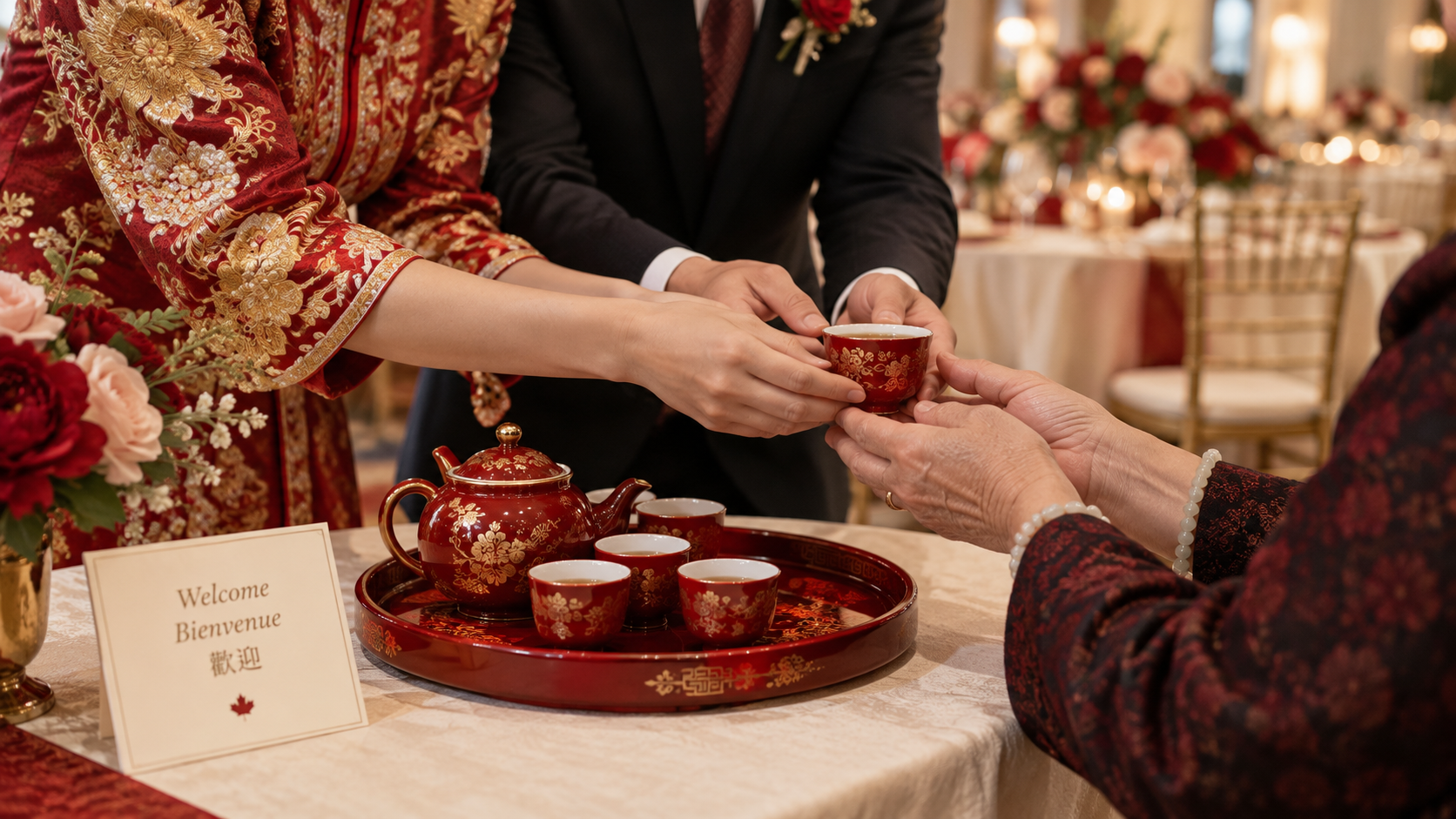
For many Chinese-Canadian couples, the wedding day is really two or three celebrations in one: a tea ceremony with family in the morning, a Western-style ceremony, and a banquet that can run to ten courses. Planning all of it, for guests who may read English, French or Chinese, takes a little more structure than a typical wedding.
This guide walks through the tea ceremony, the banquet and the guest communication, with practical tips for weddings in Vancouver, Toronto, Montréal and everywhere in between.
What is a Chinese tea ceremony?
The tea ceremony (敬茶, jìng chá) is the moment the couple formally honours their families. The couple kneels or bows and serves tea to parents, grandparents and older relatives, usually in order of seniority. In return, elders offer blessings and often a red envelope (红包, hóngbāo) or jewellery.
Customs vary a great deal between families, regions and generations. Some families hold one ceremony for both sides; others hold one at each family's home. Some follow every detail; others keep a short, symbolic version. Ask both families early what matters to them, and plan around that rather than around a checklist found online.
Planning the tea ceremony
A few decisions shape everything else:
When and where. Many couples hold it in the morning at a family home, or in a private room at the hotel or venue before the ceremony.
Who is served. Make a list in serving order, one for each side. Confirm names and titles (for example 外婆, maternal grandmother) with a parent so nobody is missed or addressed wrongly.
How long it takes. Allow roughly two to three minutes per person or couple served, plus photos. A large family can easily need an hour.
Who helps. A relative or bridesmaid who knows the customs usually prepares the tea and guides the order, so the couple can stay present.
What you need. A tea set, a tray, tea (often with red dates or lotus seeds for sweetness), cushions if you kneel, and a safe place to keep red envelopes.
Treat the tea ceremony as its own event in your schedule, with its own guest list. It is usually much smaller than the reception.
The banquet
The Chinese wedding banquet is often the largest part of the day: round tables of ten, a long multi-course menu, speeches, toasts at every table and sometimes a lion dance or games.
Practical points to settle with your restaurant or venue:
Table count and size. Banquets are usually priced per table of ten or twelve, so your final count should be rounded to full tables.
Menu and dietary needs. Traditional dishes often include seafood and pork, so ask guests about allergies and dietary restrictions on the RSVP and share them with the restaurant.
The table toast. If the couple visits every table to toast, build that time into the schedule.
Seating by family and seniority. Elders and close family usually sit nearest the head table. A seating chart that shows names clearly helps the restaurant staff and the families.
Communicating with guests in more than one language
This is where many couples spend the most time: one invitation in English, another translated for grandparents, a separate group chat for relatives overseas, and RSVPs coming in by phone.
A simpler approach:
One wedding website with the schedule, venue addresses, parking and dress code.
Guest languages set to the languages your families read, for example English and Simplified Chinese, so each guest picks their own.
Separate events for the tea ceremony, ceremony and banquet, so each guest only sees and answers for the events they are invited to.
One RSVP that records attendance per event, meal notes and allergies, linked to the same guest list you use for seating.
MapleVow supports wedding websites, RSVP forms and guest emails in English, French and Simplified Chinese. You can give each event a Chinese name as well, for example 茶礼 for the tea ceremony and 婚宴 for the banquet.
A sample day
| Time | Event | Who |
|---|---|---|
| 9:00 a.m. | Tea ceremony at the bride's family home | Immediate family |
| 10:30 a.m. | Tea ceremony at the groom's family home | Immediate family |
| 2:00 p.m. | Ceremony | All ceremony guests |
| 6:00 p.m. | Banquet reception | All banquet guests |
Every family's schedule looks different. The point is to write it down once and share it with everyone who needs it.
Frequently asked questions
Do we need a separate RSVP for the tea ceremony?
Only if the guest list is different. If only immediate family attends, keep it as a separate event and invite only those guests.
Should the wedding website be in Chinese?
If some of your guests read Chinese more comfortably than English or French, yes. It saves phone calls and makes elders feel included.
What if relatives overseas need an invitation letter for a visa?
Start early. Our guide to overseas wedding guests travelling to Canada explains how to plan for guests who are still waiting on travel documents.
Bring both traditions together
A tea ceremony, a ceremony and a banquet can sit comfortably in one day when everyone knows where to be and when. Keep one schedule, one guest list and one RSVP, in the languages your families actually read, and let the day be about family rather than logistics.