
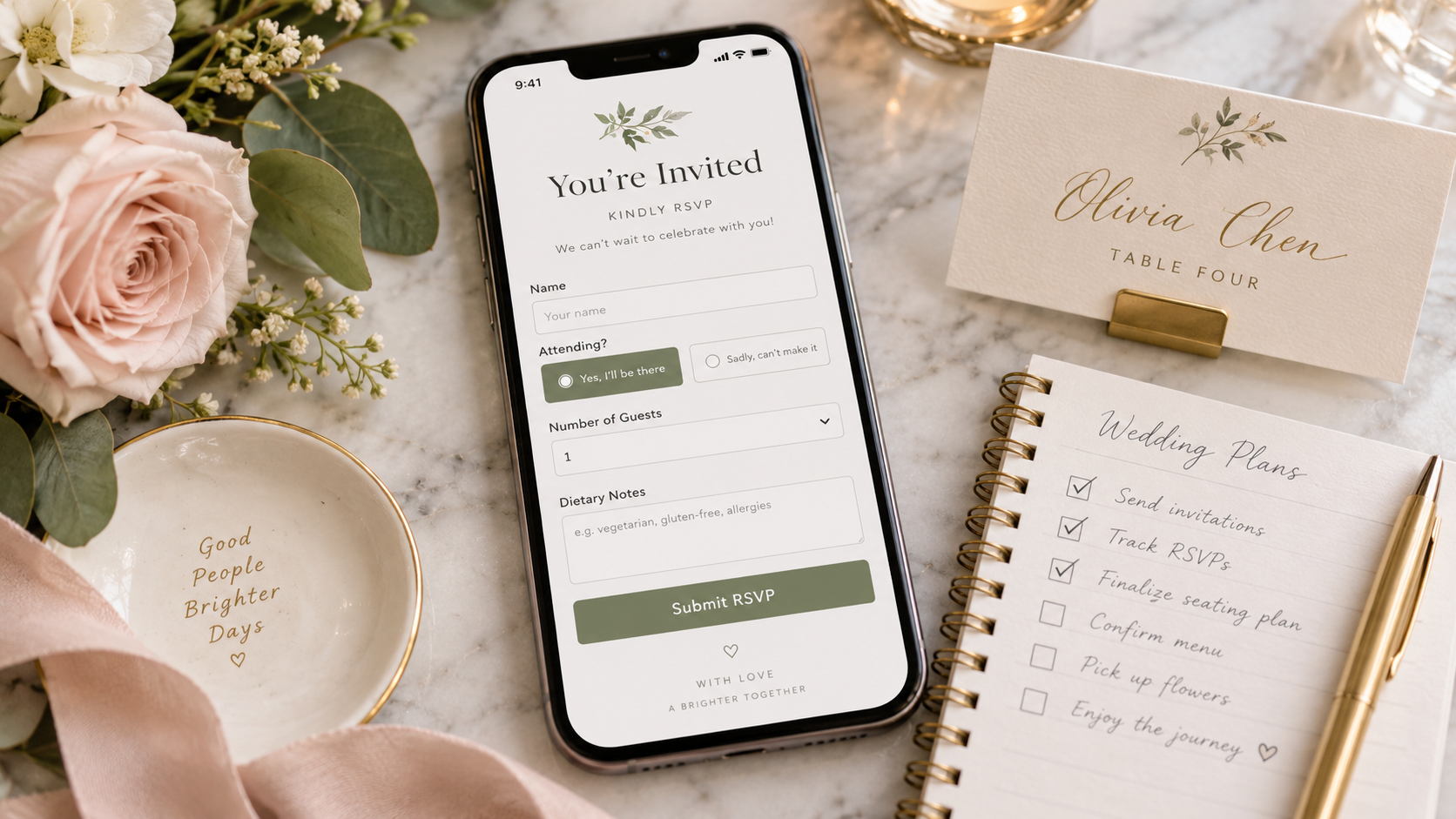
Your wedding RSVP form should answer the questions that affect a real planning decision.
That sounds obvious, but it is easy to turn an online form into an interview: song request, favourite memory, advice for the couple, hotel plans, dietary notes, shuttle times, brunch, after-party, pronouns, phone number, mailing address — all before the guest has even told you whether they are attending.
A better RSVP feels short because it is relevant. Ask essential questions first. Show optional questions only when they apply. Keep fun questions truly optional.
Here are 25 useful questions, plus guidance on when each one belongs in your form.
The essential RSVP questions
1. Will you be attending?
Example:
Will you be joining us on September 26?
Happily accepts
Regretfully declines
Every RSVP needs an unambiguous attendance response. Avoid clever wording if it makes the answer difficult to understand later.
2. Which invited guests in your household will attend?
Example:
Please select everyone who will be attending.
This matters when one invitation covers a couple or family but not every invited person can come. A household should not be forced into one all-or-nothing answer.
3. Will your invited plus-one be attending?
Ask this only when a plus-one has actually been offered.
Example:
Will you be bringing your invited guest?
Yes
No
The RSVP should not accidentally imply that every guest may add another person.
4. What is your guest's full name?
Example:
Please enter your guest's first and last name.
You will need the name for the seating chart, place card, meal assignment and day-of guest list. “+1” stops being useful very quickly once planning becomes operational.
Meal and dietary questions
5. Which meal would you like?
Example:
Please choose one entrée:
Roasted chicken
Atlantic salmon
Vegetarian mushroom risotto
If meals are assigned individually, ask the question per person rather than once per household.
6. Do you have any food allergies or dietary restrictions we should share with the caterer?
Example:
Do you have any food allergies or dietary restrictions we should know about? Please be specific.
This is more useful than a generic “Anything we should know?” box. Health Canada distinguishes food allergies from other food sensitivities and identifies priority allergens that can cause serious reactions, so allergy information deserves a clear, dedicated question.
Do not promise that every request can be accommodated unless your venue has confirmed that.
A safer note is:
We will share dietary information with our caterer and will contact you if we need clarification.
7. Is the allergy or dietary requirement associated with a specific guest?
For family invitations, make sure a note such as “peanut allergy” can be connected to the right person.
Example:
Which guest does this dietary note apply to?
8. Does a child need a children's meal?
Ask only if your caterer offers one and you are inviting children.
Example:
Would you like a children's meal for [Name]?
9. Will you need a high chair or booster seat?
This can affect both venue setup and table planning.
Example:
Will you need a high chair or booster seat for your child?
Accessibility and comfort
10. Is there an accessibility need we should plan for?
Example:
Is there an accessibility or mobility need we should be aware of to help make the day comfortable for you?
Keep the wording practical and open-ended. Do not require a medical diagnosis. The planning question is what accommodation is needed, not why the guest needs it.
11. Do you need an accessible parking space or drop-off arrangement?
Only ask this when parking or venue access needs to be coordinated.
Example:
Would an accessible parking space or closer drop-off point be helpful?
Multi-event wedding questions
12. Will you attend the ceremony?
13. Will you attend the reception?
14. Will you attend the welcome dinner, rehearsal event or mehndi/sangeet?
15. Will you attend the next-day brunch?
Do not combine several events into one vague “Are you coming to the wedding weekend?” question if you need accurate counts for each event.
With a multi-event RSVP, each invited guest can respond to the events that apply to them, and the counts stay separate.
Transportation and logistics
16. Will you use the shuttle to the venue?
Example:
Will you take the 3:30 p.m. shuttle from the hotel to the venue?
Yes
No
Ask only if the answer affects the number or size of vehicles you book.
17. Will you use the return shuttle?
The outbound and return answers may differ, especially if guests plan to leave at different times.
Example:
Which return shuttle would you prefer?
10:30 p.m.
Midnight
I will arrange my own transportation
18. Do you need on-site parking?
Useful when spaces are limited, passes must be prepared or a venue needs a vehicle count.
19. When do you expect to arrive at the destination?
For a destination wedding or remote venue only.
Example:
What day do you expect to arrive in Montréal?
Do not collect travel details just because an online form makes it possible. Ask only if you are coordinating transport, welcome events or lodging logistics.
Communication questions
20. Which language would you prefer for wedding updates?
For an English/French guest list, this can be useful when you plan to send updates in the guest's preferred language.
Example:
Which language do you prefer for wedding information?
English
Français
Either / Les deux me conviennent
If your wedding is bilingual, MapleVow supports English and Canadian French guest-facing pages when bilingual mode is enabled.
21. What is the best mobile number for day-of updates?
Only collect this if you genuinely expect to use SMS or need a reliable day-of contact method.
Explain why you are asking. Avoid collecting contact data “just in case.”
Optional questions that can still be useful
22. What song would get you onto the dance floor?
A classic optional question that can give the DJ useful ideas without affecting the RSVP itself.
23. Would you like to leave a note for the couple?
A free-text note can be warm and personal, but place it near the end so it does not slow down critical planning information.
24. Is there anything about your invitation or attendance we should clarify?
This is a good catch-all for unusual situations — but it should not replace specific questions about allergies, plus-ones or accessibility.
25. Do you need us to follow up about anything before the wedding?
This gives guests a safe way to flag something that does not fit the form without forcing them to guess which field to use.
Example:
Is there anything you'd like us to follow up with you about? Optional.
Questions you probably do not need
The fact that a form can collect information does not mean it should.
Think twice before asking every guest for:
Their full mailing address again if you already have it
Detailed flight numbers when you are not arranging transportation
Hotel room numbers
Medical diagnoses
Social media handles
A long “how do you know us?” questionnaire
Registry or gift information
Multiple fun questions that make the form feel longer than the planning questions
Every additional field creates a little more work for the guest and a little more data for you to manage.
The best order for an RSVP form
A clean order is usually:
Attendance
Household members attending
Plus-one, if invited
Event-by-event attendance
Meal selection
Allergy/dietary information
Children/high chairs, when applicable
Accessibility
Transportation/logistics
Optional message or song request
That order follows the couple's decision-making needs. If someone declines, the form can often skip questions about meals, shuttles and dancing altogether.
Use conditional questions whenever possible
Good RSVP logic keeps irrelevant questions out of the way.
Examples:
If guest declines → skip meals, shuttle and high-chair questions.
If plus-one = no → do not ask for the plus-one's name or meal.
If child is not attending → do not ask about a high chair.
If shuttle = no → do not ask for a departure time.
If no dietary restrictions → do not require a long notes field.
MapleVow's RSVP builder can collect meals, dietary information, plus-one details, high-chair needs and custom questions while keeping responses connected to the guest list.
Questions should map to something you will actually do
A useful final test is to ask yourself:
If a guest answers this question, what decision will we make differently?
If the answer is “none,” consider removing it.
For example:
Meal choice → caterer count
Allergy → caterer note and possible follow-up
Plus-one name → seat and place card
High chair → venue setup
Shuttle → transportation capacity
Brunch attendance → catering count
Accessibility need → venue arrangement
That is the difference between a form that collects data and a form that helps plan a wedding.
A sample concise RSVP flow
Here is what a well-designed RSVP might feel like for an invited couple:
Will you attend Emma & James's wedding on September 26?
Yes — happily! / No — with regrets
Who from your invitation will attend?
☑ Alex Morgan
☑ Taylor Morgan
Choose a meal for Alex
Chicken / Salmon / Vegetarian
Choose a meal for Taylor
Chicken / Salmon / Vegetarian
Any food allergies or dietary restrictions?
Optional text field
Will you use the hotel shuttle?
Yes / No
What song will get you on the dance floor?
Optional
That is enough to produce useful counts without making the guest complete a survey.
Frequently Asked Questions
How many questions should a wedding RSVP have?
There is no ideal number. Ask the minimum number needed for your actual event.
A simple ceremony and reception may need only attendance, meals and dietary information. A destination or multi-event wedding will naturally need more.
Should I ask about dietary restrictions or allergies?
Yes if food is being served and the information will be passed to the caterer.
Make the question specific and connect the response to the individual guest when possible.
How do I ask about plus-ones without implying everyone gets one?
Show the plus-one question only to guests who have been offered one, or use wording such as “Will your invited guest be joining us?”
Personalized RSVP flows are useful here.
Should I ask guests for their phone number?
Only when you have a clear reason, such as SMS invitations/reminders or important day-of updates.
Tell guests why it is being requested.
Should RSVP questions be bilingual?
If a meaningful part of your guest list is more comfortable in French, offering a Canadian French experience can make the form easier to understand and more welcoming.
Keep choices and event names consistent across both languages.
Build the RSVP around decisions, not curiosity
The best RSVP form quietly does a lot of work for you.
It tells you who is coming, what they will eat, who needs special arrangements, how many seats belong at each event and which details still need follow-up.
MapleVow keeps those answers tied to the guest record so they can carry forward into reminders, meal counts and seating instead of becoming another spreadsheet to reconcile.
Ask less. Ask better. Use every answer.
References
Health Canada — Food allergies and intolerances
https://www.canada.ca/en/health-canada/services/food-nutrition/food-safety/food-allergies-intolerances/food-allergies.htmlMapleVow — Online Wedding RSVP in Canada
https://maplevow.ca/wedding-rsvp-canadaMapleVow — Multi-Event Wedding RSVP
https://maplevow.ca/multi-event-wedding-rsvpMapleVow — Inclusive Wedding RSVP Wording
https://maplevow.ca/inclusive-wedding-rsvp-wording