
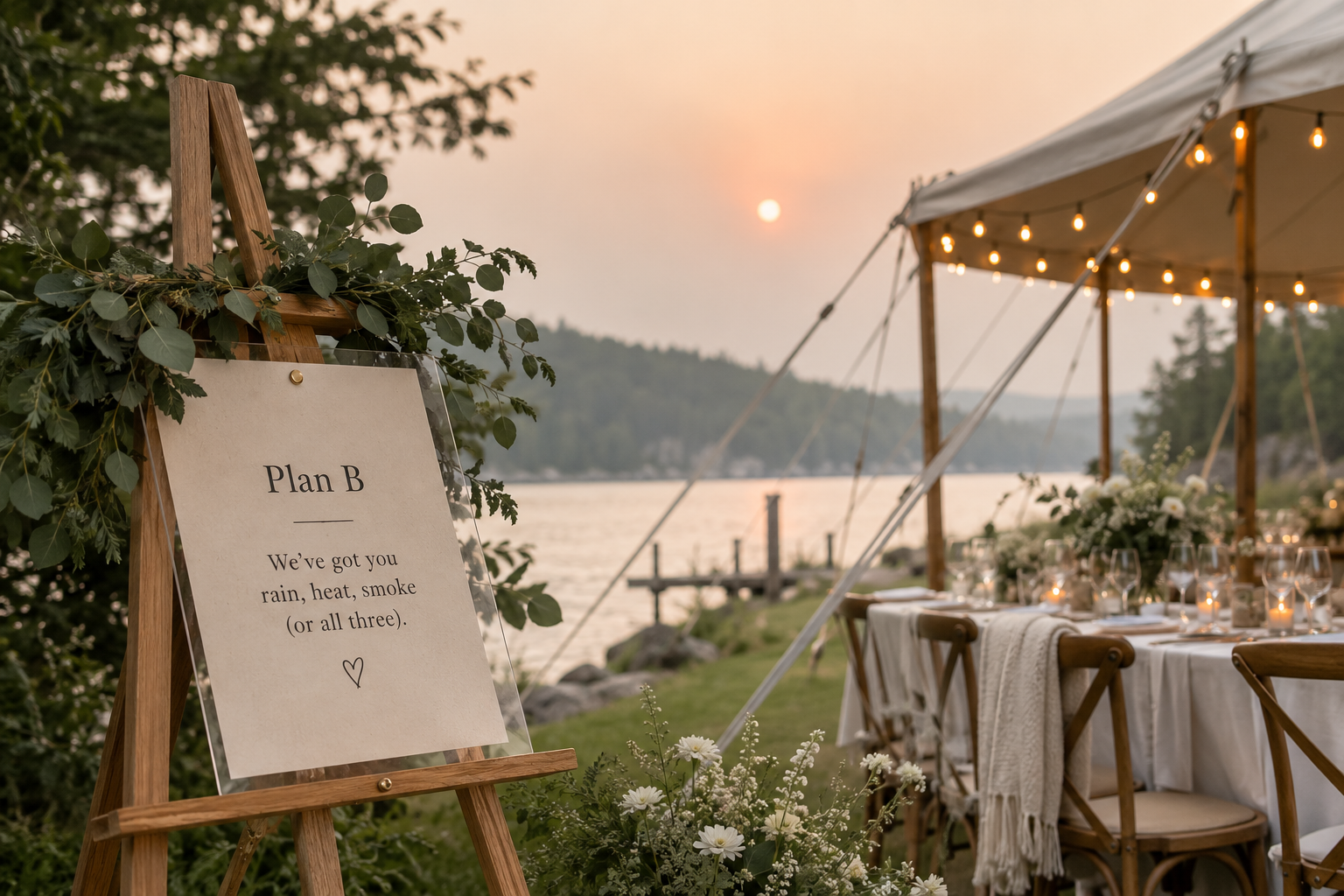
An outdoor wedding in Canada now needs a backup plan for more than rain.
Tent and backyard celebrations keep gaining ground, and the same summers that make them appealing have also brought smoke advisories, heat warnings and wind strong enough to tear through décor.
The 2025 wildfire season was Canada's second-worst on record, with more than 6,000 fires and over 8.3 million hectares burned.
And smoke travels. Air quality can affect your wedding day even when the nearest wildfire is hundreds of kilometres away.
None of this means giving up on an outdoor ceremony. It simply means deciding, before wedding week, exactly what would move the celebration indoors — and making sure the right people already know the plan.
More than a rain plan
The classic rain plan covers one scenario. A Canadian outdoor wedding in summer realistically faces four:
Rain
Wildfire smoke
Extreme heat
Strong wind
They don't behave the same way.
Rain often appears in the forecast several days ahead. Smoke can arrive overnight from a wildfire two provinces away. Heat tends to build more gradually, but it can change how long guests are comfortable sitting outside, especially children and older guests.
A tent can handle rain and provide shade, but it does not filter wildfire smoke.
Think of a tent as weather protection — not air-quality equipment.
Agree on your triggers before wedding week
The most useful conversation to have with your venue and vendors isn't simply "What if it rains?"
Ask instead:
What, specifically, would cause us to move indoors?
Possible triggers include:
An air-quality advisory or an AQHI forecast you're not comfortable with
A heat warning
Wind above your tent supplier's rated limit
Heavy or persistent rain
An evacuation alert or road closure near the venue
Any safety limit set by a vendor for their equipment or staff
Then put three things in writing:
Where the backup celebration will take place
The latest time the setup can realistically be moved indoors
Who makes the final decision
Choose one person to make the call.
Not a group chat.
For smoke, check the index — not the sky
A blue sky isn't proof of clean air, and visible haze doesn't automatically mean conditions are unsafe.
The Government of Canada's Air Quality Health Index (AQHI) rates air-quality conditions on a scale from 1 to 10+, with forecasts available for the days ahead. Quebec uses Info-Smog.
Health Canada's wildfire smoke guidance recommends considering three things when deciding whether an outdoor activity should continue:
The current air quality
The type and intensity of the activity
Who will be participating
That last point matters at a wedding.
If your guest list includes babies, pregnant guests, older relatives or people with heart or lung conditions, it can be worth planning a comfortable indoor option even when conditions aren't severe.
You can also monitor wildfire activity around your venue through Natural Resources Canada's wildland fire map.
Heat, wind and storms
Health Canada's extreme heat advice recommends using cooler parts of the day, shade and air-conditioned spaces when possible.
For a wedding, that can mean:
Moving the ceremony or photos earlier or later in the day
Providing water where guests are actually gathering — not only at the bar
Creating shaded areas for outdoor portions of the celebration
Confirming that your indoor backup space is genuinely cool and comfortable
Wind is usually a conversation for your tent or rental supplier.
Ask what wind speed requires the tent to be closed or taken down, and confirm who will monitor conditions on the wedding day.
Lightning is much simpler:
Everyone goes inside.
That includes the wedding party, vendors and photographer.
Your 72-hour weather countdown
72 hours before
Check the weather forecast along with the AQHI or Info-Smog outlook.
Confirm that your backup space is still available and ready to use. Remind your venue and key vendors who has authority to make the final call.
24 hours before
Check everything again.
If conditions are trending in the wrong direction, alert vendors early so you still have enough time to switch setups without creating unnecessary chaos.
Wedding morning
Check current conditions one final time.
At the agreed decision time, make the call and notify guests immediately.
Don't send one text at a time.
Questions worth asking your venue
Before signing off on your outdoor plan, ask:
Which indoor space will be ours if we need it?
How many guests does it realistically hold once dinner tables, the dance floor and the band or DJ are set up?
How late can the room be switched from the outdoor setup?
Who is responsible for moving everything?
Is there an additional fee for switching locations?
Is there enough power for fans or portable air cleaners if they're needed?
Our guide to choosing wedding vendors goes deeper into the backup-plan questions worth asking before booking.
One clear update beats a hundred texts
Add a simple line to your wedding website:
If weather or smoke changes our location or timing, we'll update this page and contact you.
Collect a mobile number or email address with every RSVP so a last-minute update can go out as one message instead of turning into a phone tree.
MapleVow's RSVP tools keep your guests' contact information together in one place for situations exactly like this.
And choose someone to send the update who is not getting married that morning.
A weather plan isn't pessimistic.
It's what allows you to enjoy the outdoor version of your wedding knowing the indoor version is already prepared — and nobody has to invent a backup plan at 9 a.m.