
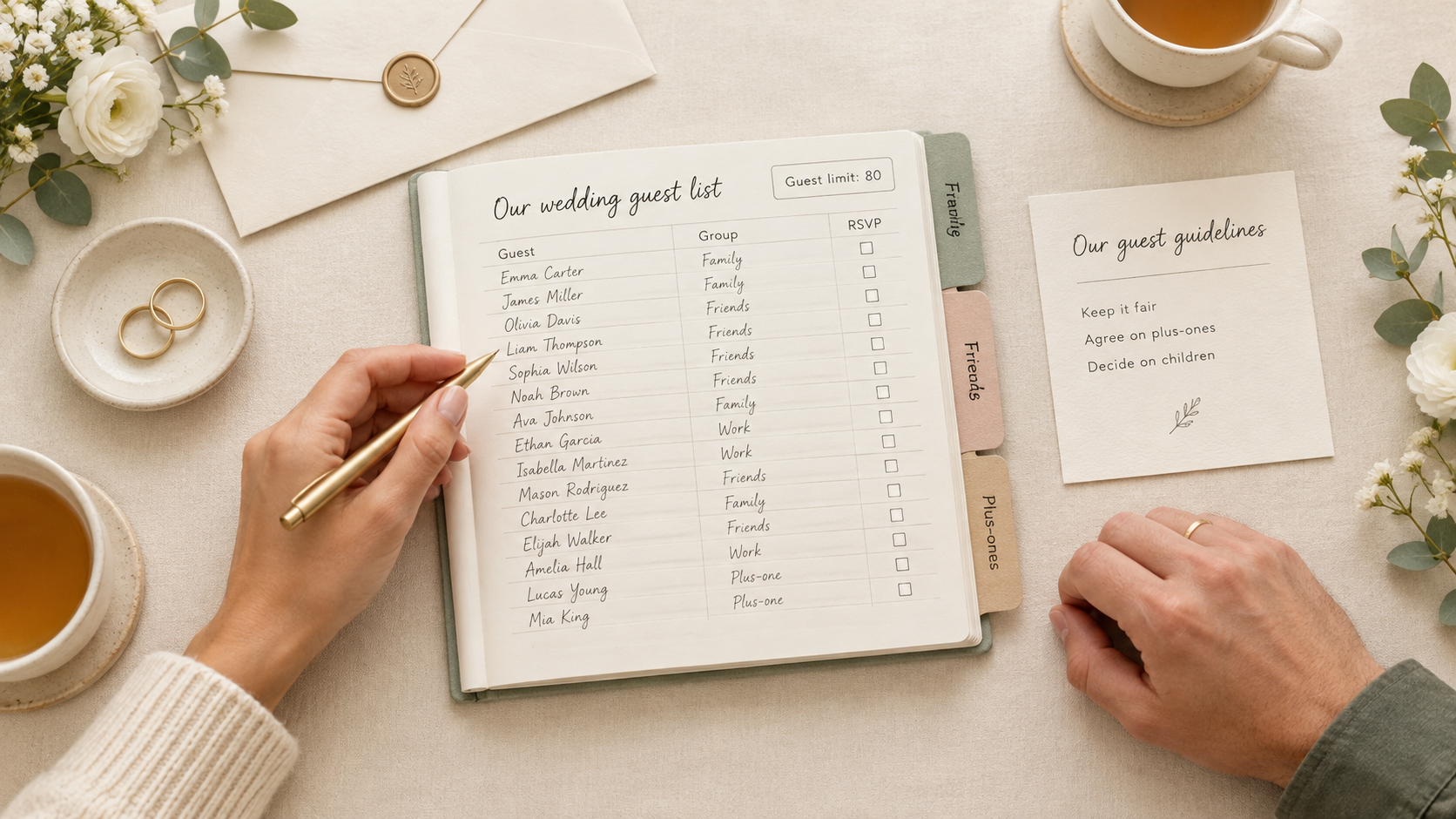
The guest list is the first big decision of wedding planning and often the hardest. It sets your budget, decides which venues fit, and involves the feelings of two families at once.
Here is a calm, step-by-step way to build it, with simple rules for the hard cases and a few tips for Canadian weddings with guests in several provinces or countries.
Step 1: Start with a number, not names
Before anyone writes a name, agree on a rough total. It usually comes from two places:
Your budget. Food and drink are usually priced per guest, so each extra guest costs more than their meal.
The venues you like. A room for 80 cannot hold 150, however much you want it to.
Write the number down. It is easier to say "we agreed on 120" than to argue about one person at a time.
Step 2: Split the list fairly
Decide how the total is divided before filling it. Common approaches:
Thirds: one third for each family and one third for the couple.
Halves: half for each side, including friends.
By who pays: families contributing more get more spots.
There is no right answer, only one everyone agreed to. Say it out loud early.
Step 3: Use tiers
Ask everyone involved to list their guests in three tiers:
Must invite: immediate family, closest friends, the people you cannot picture the day without.
Should invite: extended family and good friends you see regularly.
Nice to invite: colleagues, plus-ones you have not met, family friends you rarely see.
Fill tier 1 first, then tier 2, and only then tier 3 if there is room. When you need to cut, you cut from the bottom, and nobody has to defend a single name.
Step 4: Set rules for the hard cases
Decide these once, for everyone, so you are not deciding them guest by guest:
Plus-ones. For example: married, engaged or living-together couples are invited together; single guests get a plus-one only if they will not know anyone else.
Children. All children, family children only, or adults only.
Colleagues. Your whole team, only close work friends, or none.
The "have we spoken in two years?" test. If not, they can probably come off tier 3.
Clear rules make kind conversations easier: "We are keeping it to family children only" is easier to hear than a personal explanation.
Step 5: Organize by household
Invitations, RSVPs and seating all work by household, not by single person. For each household, record:
every invited person's full name, including children and named plus-ones;
one email address or phone number to send the invitation to;
a mailing address if you are sending paper invitations;
which events they are invited to (for example the tea ceremony, ceremony or brunch);
the language they prefer, if your families read different languages.
With MapleVow's guest list manager, each household is one party with its members, so the RSVP shows each person by name and you know exactly who is coming.
Step 6: Plan for guests who travel
Canadian weddings often bring guests from other provinces and overseas. For them:
send save-the-dates earlier, about 8 to 12 months before;
add travel and hotel details to your wedding website;
expect some to answer "maybe" while they wait for time off or a visa.
Step 7: Expect some guests to decline
Not every invited guest will come. Travel, health, cost and schedules all play a part, and destination weddings usually see more declines than local ones. Look at your own list: how many guests live far away, have young children or have other commitments that week?
If you have a waiting list, send those invitations early enough that the second wave of guests still has time to plan. Never let a guest feel like a backup.
Step 8: Keep one list
The fastest way to lose control of a guest list is to keep several: a spreadsheet for addresses, a group chat for RSVPs, notes on a phone for meals. Keep one list that every other step reads from: invitations, RSVPs, reminders, meal counts and seating.
Frequently asked questions
How do we cut the guest list without hurting feelings?
Use tiers and clear rules, cut from the bottom tier, and apply the same rule to both sides. It is much easier to explain a rule than a single decision.
Do we have to give every single guest a plus-one?
No. Many couples invite partners in established relationships and give plus-ones only to guests who would not know anyone else.
When should the guest list be final?
Have a near-final list before you send invitations, about three to five months before the wedding, and the confirmed list after your RSVP deadline.
A list that does the work for you
A good guest list is more than names. It holds households, events, contact details and answers, and it feeds everything that follows. Build it once, carefully, and the rest of your planning gets simpler.