
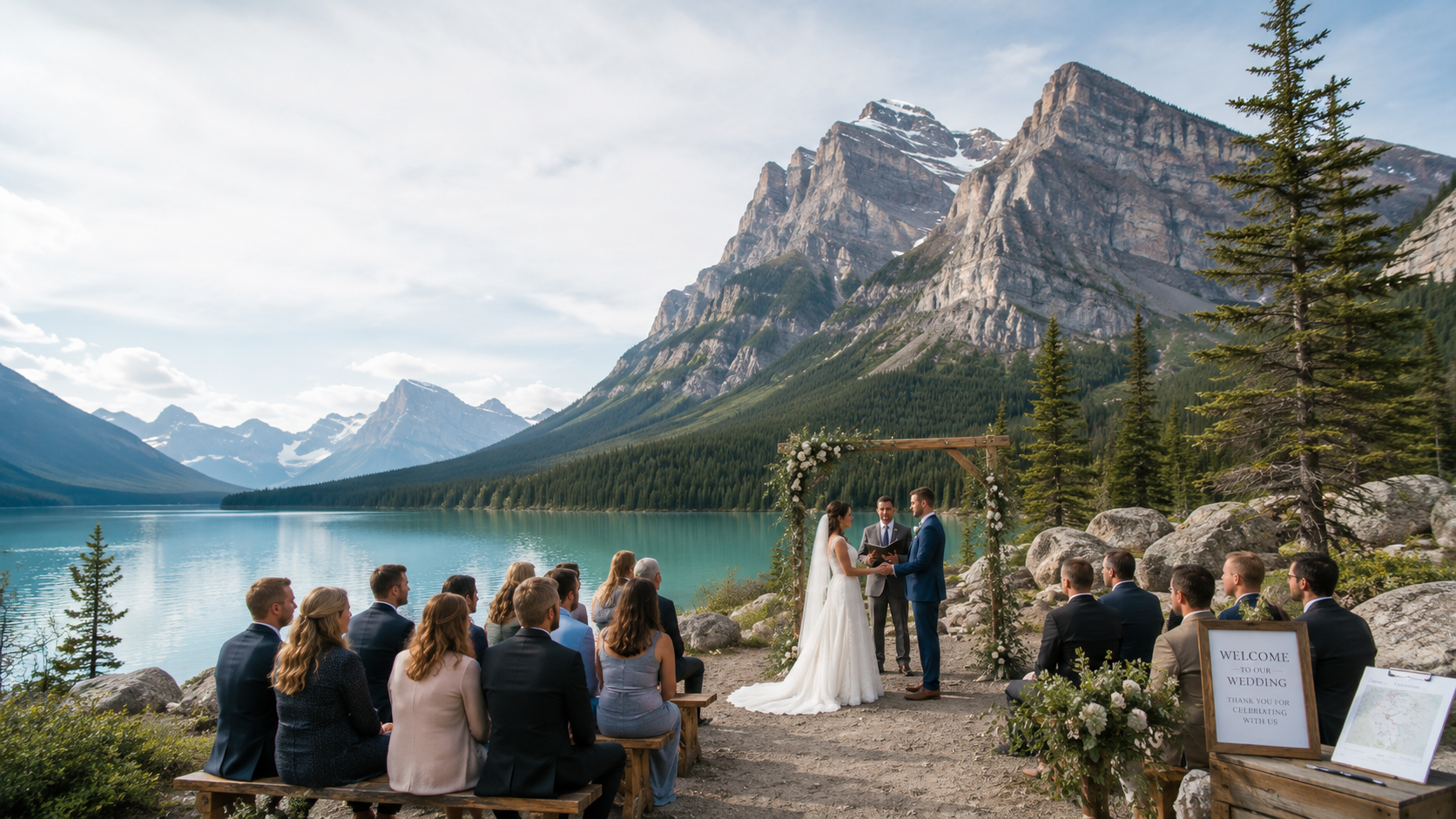
The most expensive mistake in national-park wedding planning is assuming there’s one set of rules.
There isn’t.
Parks Canada manages each park separately, and the wedding requirements genuinely differ from one park to the next.
The planning order matters:
Pick the exact park and ceremony location.
Read that park’s current Parks Canada wedding requirements.
Confirm permits, capacity and vendor rules.
Only then start booking vendors.
Three Parks, Three Different Rulebooks
Banff National Park
Banff requires wedding organizers to complete a registration form.
Key rules include:
Maximum ceremony size: 20 participants
Everyone still needs a valid park entry pass
Public locations remain public — you do not get exclusive use
Hikers and visitors may pass through your ceremony area
Businesses operating inside the park, including wedding photographers, may require a business licence
Important: Banff’s 20-person limit is a participant limit, not simply a “20 guests plus everyone else” limit.
Pacific Rim National Park Reserve
Pacific Rim takes a different approach.
A wedding permit is required for every wedding, regardless of size.
Two people and an officiant on the beach?
It still counts.
Cape Breton Highlands National Park
Cape Breton Highlands states that permission is required to hold a wedding inside the park.
That gives you three parks with three different systems.
Do not assume Banff’s rules apply to Jasper, Gros Morne, Pacific Rim or anywhere else.
Check the Parks Canada page for your exact park — and check it again closer to the wedding date because requirements can change.
Before You Invite Anyone
Work through these questions while your guest count is still theoretical.
Guest capacity
What does the ceremony-size limit actually include?
For example, Banff’s 20 participants includes the couple, so don't automatically build a 20-person guest list.
Park entry
Figure out:
Does every guest need a park pass?
Who is paying for them?
Do guests need to display or carry anything?
Public access
If you're getting married at a public viewpoint, trail or lakeshore, prepare guests for the fact that strangers may be nearby.
Your ceremony may have an unexpected audience wearing hiking boots.
Vendors
Confirm which vendors need permission or licensing to operate inside the park, including:
photographers
videographers
planners
officiants
musicians
transportation providers
The actual location
Check the ceremony spot itself — not simply the visitor centre.
You need to know:
parking availability
washroom access
cell coverage
walking distance
terrain
accessibility
seasonal closures
wildlife restrictions
allowed décor and equipment
And when it comes to décor, assume the answer is less than you'd normally expect at a traditional venue.
The Guest Logistics Nobody Warns You About
A park ceremony effectively turns your wedding guests into day hikers.
Some of them may not have hiked in twenty years.
Don't write:
Ceremony at Lake Agnes trailhead.
Your aunt visiting from Windsor probably has no idea what that means.
Instead, give guests:
Meeting point
Include a precise location or map pin.
Walking distance
For example: 15-minute walk from parking.
Terrain
Gravel? Pavement? Stairs? Steep incline?
Footwear recommendation
Tell people before they arrive in formal shoes that won't survive the trail.
Accessibility information
Plan how grandparents and guests with mobility needs will reach the ceremony before someone has to ask.
Have a Real Weather Plan
Weather deserves a decision plan — not:
Hopefully it doesn't rain.
Mountain conditions can change quickly, and wildfire smoke can affect visibility, access or even close parts of a park.
Our outdoor wedding weather guide covers a 72-hour decision framework.
For a national-park wedding, add one more check:
Review the park's current closures, restrictions and advisories before the ceremony.
Ceremony in the Park, Party in Town
For many couples, the simplest setup is:
Small ceremony in the national park → reception in town
For example:
3:00 PM — Ceremony at the viewpoint
3:30 PM — Photos
5:30 PM — Reception in Banff, Canmore, Tofino or another nearby town
This setup solves several problems at once.
You get:
easier washroom access
weather protection
proper seating
food and alcohol service
fewer park restrictions
more flexibility with your reception guest count
It can also allow the ceremony and reception to have different guest lists.
You might invite:
10 people to the ceremony
and
60 people to dinner
But that creates another logistical challenge: two locations, two start times, separate directions and guests invited to different parts of the day.
That's exactly where Multi-event RSVP helps.
Guests can RSVP separately to each event, giving you accurate attendance and meal counts instead of trying to manage everything manually.
What to Put on Your Wedding Website
Park weddings depend heavily on good guest communication.
Your wedding website should clearly show:
📍 Meeting point
Include the exact location or map pin.
🚗 Travel time
Explain how long it takes to get there from the hotel or town.
🥾 Walking conditions
Example: 15-minute walk, gravel path, gentle uphill.
👟 What to wear
Especially footwear.
🌦 Weather plan
Explain what happens if conditions change.
⏰ Ceremony time
Include both the meeting time and actual ceremony start time.
🎟 Park passes
Tell guests whether they need one and how to get it.
🍽 Reception details
Keep the reception as a separate section with its own time, address and directions.
One Final Shortcut: Hire People Who Know the Park
Local vendors who regularly work inside the park already understand many of its permit requirements, access limitations and logistical quirks.
That experience can save you a lot of unnecessary research.
Our vendor directory is a good place to start.
Then file the permit, watch the forecast, send your guests very clear directions —
and get married somewhere most people only ever see on a postcard.