
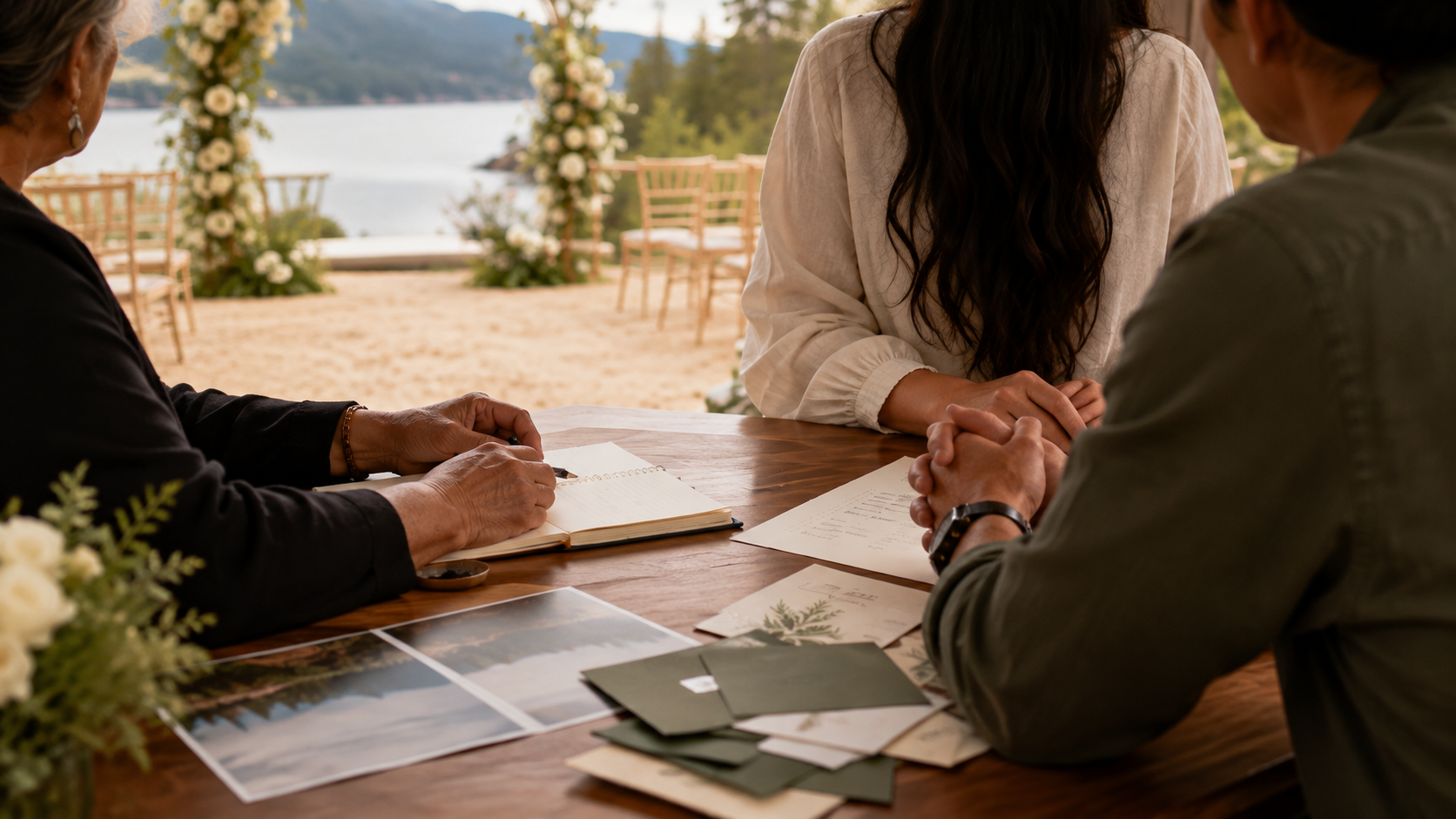
This guide is for Indigenous couples, and for intercultural couples with a real relationship to a specific community, who want their wedding to be grounded in their own protocols.
One thing it will not do is tell you what those protocols are, because nobody outside your community can do that for you.
The 2021 Census counted just over 1.8 million Indigenous people in Canada, and the Government of Canada itself is careful to describe First Nations, Inuit and Métis as distinct peoples with their own histories, cultures and heritage.
So a generic article promising a single "traditional Indigenous wedding" ceremony is describing something that doesn't really exist.
What a planning guide can do is help with the process: the questions to ask, the people to ask them of, and the practical decisions that follow.
Start with your own community, not a search engine
Planning begins with your family, your Nation or community, and the Elder, Knowledge Keeper or other person your community recognizes as the right person to guide the ceremony.
What they tell you takes priority over anything published online — including this article.
If you grew up away from your community and are reconnecting, that first conversation may become part of the wedding journey itself.
Give it time.
Some answers may take more than one visit, and some protocols are learned through participation rather than explained in a single conversation.
Questions to ask early
Useful questions can include:
Who may lead the ceremony?
Who should witness it?
Which parts of the ceremony are public?
Are any parts private or not meant to be recorded?
Is photography or video permitted, and during which moments?
How should guests dress or behave?
Are gifts or honoraria appropriate?
Who should receive them, and how should they be offered?
What should vendors know before they arrive?
Are there seasonal, location-specific or ceremonial timing considerations?
If appropriate, write the answers down with the blessing of the person guiding you.
Those notes can then become the foundation for your vendor briefings, guest instructions and wedding-day schedule.
Tell guests what they need — and nothing more
Guests need enough information to participate respectfully.
That might include:
What to wear
When to stand or sit
Whether photography is allowed
How to greet certain people
Any expectations around entering or leaving the ceremony space
They do not need an explanation of teachings, meanings or ceremony elements that your community doesn't share publicly.
Leaving restricted knowledge off your wedding website is not a communication failure.
It is the communication working exactly as intended.
A short, approved note is often enough: explain the day in broad terms, tell guests what is expected of them, and give them one person to contact with questions.
Have the person guiding your ceremony review that wording before it goes out.
Hosting an Elder or Knowledge Keeper well
If an Elder or Knowledge Keeper is part of your wedding, their care deserves its own planning checklist.
Confirm things such as:
How the invitation should properly be made
Travel arrangements
Arrival and transportation
Who will welcome and stay with them
Meals and dietary needs
A quiet or private space
Any mobility or accessibility considerations
Whether an honorarium or gift is appropriate
How and when that honorarium should be offered
These details are better handled respectfully and in advance than improvised at the end of the night.
Indigenous Corporate Training's guidance on Elder protocol covers some practical considerations, but the most important point is the same throughout: protocols differ between Nations and communities, so always confirm the specifics locally.
The legal side is a separate question
A ceremony can be fully meaningful and valid within your community while still requiring separate civil paperwork.
That means it's worth checking the cultural and legal sides early rather than assuming one automatically covers the other.
Ontario's Marriage Act includes a mechanism through which an eligible Indigenous entity may be recognized as entitled to solemnize marriages according to its own customs and traditions.
That is specific to Ontario.
If you're marrying in another province or territory, confirm the legal requirements with the appropriate provincial or territorial authority.
Some couples hold their community ceremony and complete the civil registration separately.
The important part is knowing which signatures and documents are required before the wedding, not discovering a missing piece months later.
Brief your vendors in writing
Photographers and videographers need to know the boundaries before they arrive.
Tell them clearly:
Which moments may not be photographed or filmed
Whether video is permitted at all
Whether drones are allowed
Who they may approach with questions
Whether certain objects, people or spaces should not be recorded
Caterers may need information about food protocols.
The DJ or MC may need help with pronunciation, introductions and the order of events.
A one-page vendor briefing sheet, reviewed by the person guiding your ceremony, can prevent one of the worst wedding-day mistakes: a well-meaning vendor documenting something that should never have been recorded.
Keep the moving parts together
A community-grounded wedding can involve more moving parts than a standard ceremony-and-reception schedule.
The ceremony and reception may have different guest lists. Some guests may be invited to one part of the day but not another. Meals, transportation and instructions may also vary between events.
MapleVow's multi-event RSVP can manage who is invited to which events, with separate attendance and meal responses.
Your wedding website can carry the guest-facing information that has been approved for sharing, including travel details, timing and participation instructions.
Private notes can stay attached to individual guests instead of being scattered through texts, emails and group chats.
The tool should follow the community's lead — never the other way around.
Get the protocol conversations right first.
After that, the logistics are just logistics.