
Executive summary
If you want a friend to lead your ceremony, start with the law of the province or territory where you are getting married. In Canada, a legal marriage ceremony must be performed by someone the local law recognizes as authorized. That can include a registered religious officiant, marriage commissioner, justice of the peace, judge, clerk, notary, or a specially designated person, depending on the jurisdiction. An online ordination from another country does not automatically create that authority on its own. [2]
The rule that actually matters
A simple online ordination certificate is often misunderstood as a universal licence to marry people. It is not. Provinces and territories decide who may solemnize marriages performed within their borders, and several official sources say the marriage must be performed by someone authorized or registered under local law. Ontario’s Marriage Act states that no person may solemnize a marriage unless registered as authorized under the Act. British Columbia says any person performing a marriage must be registered with the Vital Statistics Agency. Alberta says a person must be legally authorized by Vital Statistics to perform a marriage there. Quebec says a marriage must be solemnized by an officiant recognized by law and authorized to solemnize marriages. [3]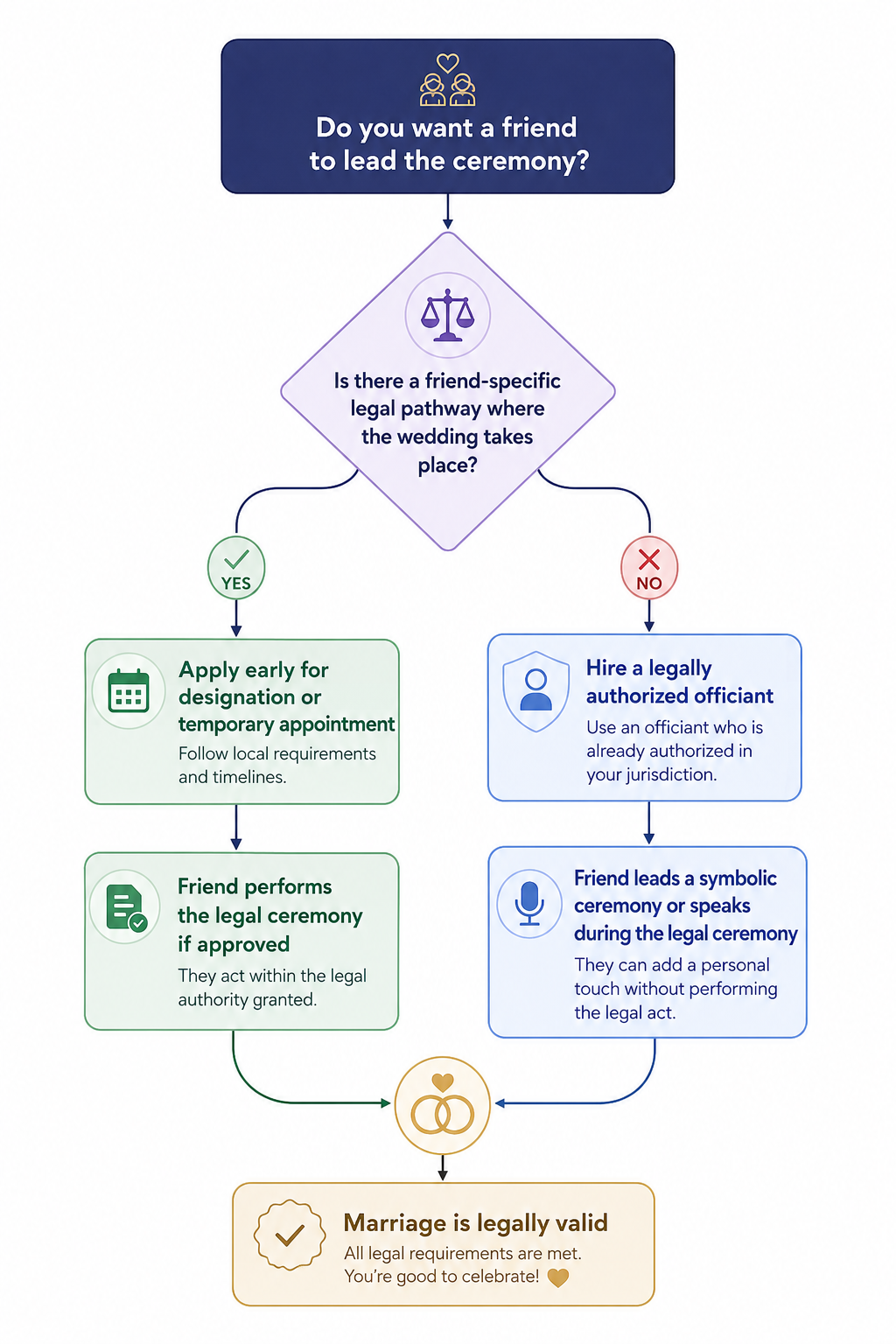
Province-by-province comparison
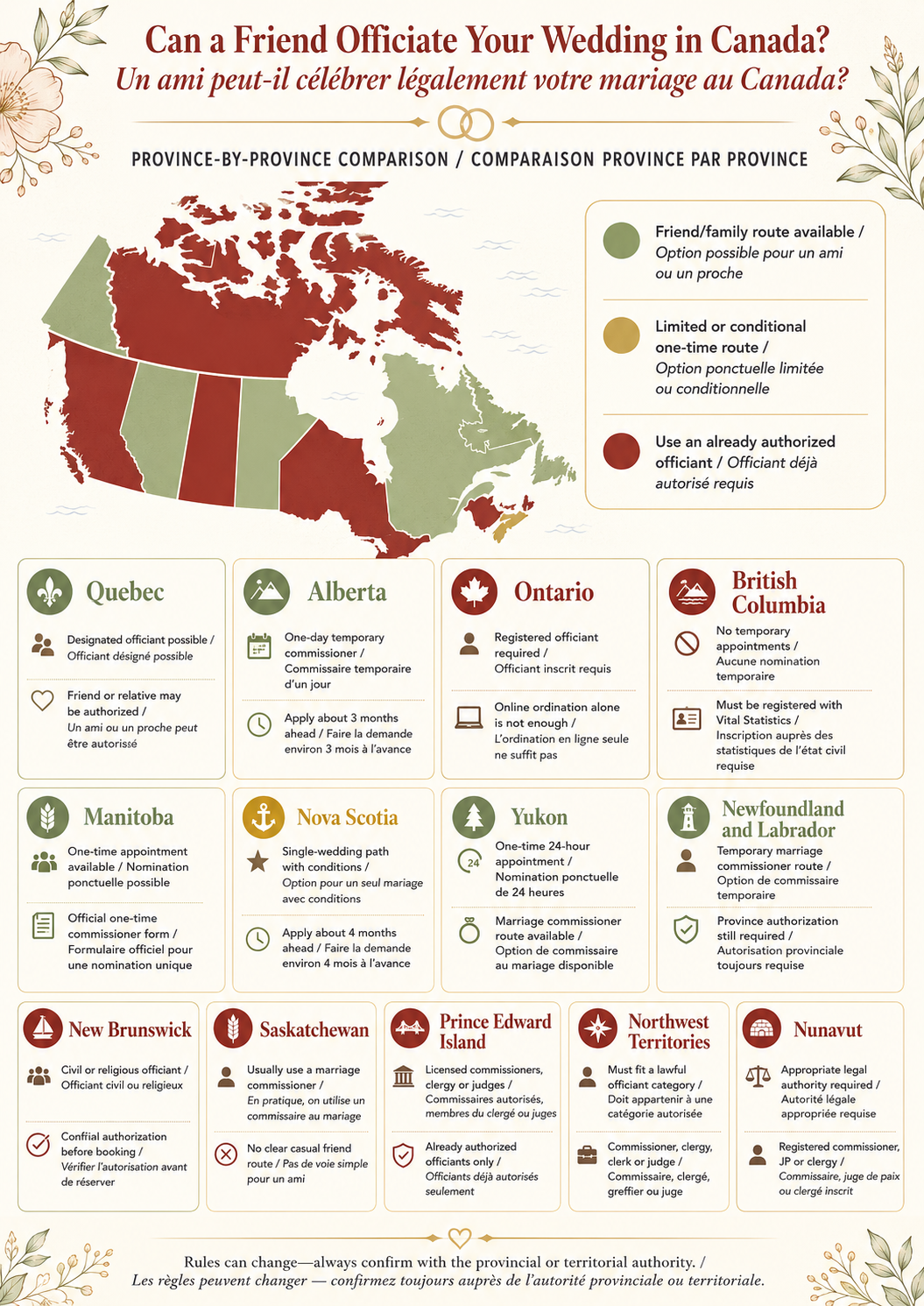
Quebec
Quebec is the clearest province if you want a friend or family member to officiate a civil marriage. The province says a relative or friend may solemnize the marriage if that person meets the conditions and is authorized as a designated officiant by the registrar of civil status. The designated officiant then has mandatory pre-ceremony and post-ceremony duties, including meeting the couple, reviewing documents, posting the notice of publication, and sending the required documents after the ceremony.
Alberta
Alberta has a formal one-day solution. Temporary marriage commissioners are appointed for one day to perform a civil marriage ceremony. The applicant must be at least 18, a permanent resident of Canada, and may perform only civil ceremonies in Alberta. Alberta recommends applying at least three months in advance.
Ontario
Ontario is stricter about legal authority. The marriage must be performed by an authorized officiant under Ontario’s Marriage Act, and the province maintains a register of marriage officiants. In practice, that means couples should work with a person already authorized and registered under Ontario law rather than assume a friend’s online ordination is enough.
British Columbia
British Columbia does not offer temporary appointments for one-off friend officiants through its marriage commissioner program. The province says any person performing a marriage in B.C. must be registered with the Vital Statistics Agency, and its page on becoming a marriage commissioner expressly says temporary appointments are not provided because of the amount of training involved.
Manitoba
Manitoba offers a one-time appointment process. The official application is specifically titled “Application for One-Time Appointment as a Manitoba Marriage Commissioner,” and it says to use that form if you wish to solemnize one marriage ceremony.
Nova Scotia
Nova Scotia has a single-wedding pathway, but it is not open-ended. The Civil Weddings Program fact sheet says a person seeking appointment as an Administrative Justice of the Peace for a single wedding must be a resident of Nova Scotia, a judge or clergy, or already authorized to preside over weddings in the jurisdiction where they live. Applications should be submitted four months before the wedding.
Yukon
Yukon allows marriage commissioner appointments, including one-time 24-hour appointments. Yukon’s government says you can apply to become a marriage commissioner and lists fees for a three-year appointment, renewal, and a one-time 24-hour appointment. Yukon also says a marriage commissioner, cleric, or justice of the peace can perform the marriage.
Newfoundland and Labrador
Newfoundland and Labrador publicly lists marriage commissioners and temporary marriage commissioners as lawful officiants, alongside clergy registered under the Act and judges. That means there is an official route for temporary appointments, but you still need the province’s authorization.
New Brunswick
New Brunswick says marriages may be solemnized by a religious officiant or a civil officiant, and civil officiants may solemnize civil marriage ceremonies throughout the province. The public guidance does not present a casual friend designation route; couples should confirm that the chosen officiant is actually authorized before booking.
Saskatchewan
Saskatchewan’s public guidance centres on marriage commissioners and clergy. If you want a non-religious ceremony, the practical path is usually to book a marriage commissioner rather than assume a friend can be authorized for one day.
Prince Edward Island
Prince Edward Island says only judges, local clergy registered under the Marriage Act, and licensed marriage commissioners can solemnize marriage, which again points couples toward already authorized officiants rather than informal online ordination.
Northwest Territories
The Northwest Territories state that legal marriages may be solemnized by clergy designated by religious organizations, marriage commissioners, deputy clerks of the Supreme Court, and judges. A friend would need to fit one of those lawful categories.
Nunavut
Nunavut says a marriage must be solemnized by someone with appropriate authority. For civil marriages, that means a registered marriage commissioner or registered justice of the peace; for religious marriages, a registered clergy member or other registered religious representative.
What couples should do in practice
If your province has a legal friend pathway, apply early and use the official process exactly as written. If it does not, separate the emotional role from the legal role. Your friend can still welcome guests, tell your story, lead vows, or speak during a symbolic ceremony, while an authorized officiant handles the legal solemnization and paperwork. That approach is often the safest fallback where local law requires a registered officiant.
Questions couples ask most often
Does online ordination automatically let my friend marry us in Canada?
No. The local province or territory decides who can legally solemnize marriages performed there, and several jurisdictions expressly require registration or official authorization.
Can our friend lead the ceremony even if they cannot legally sign the marriage?
Yes. The legal and ceremonial roles can be separated. Many couples have an authorized officiant handle the legal ceremony while a friend leads part or all of the personalized speaking portion. That is a planning choice rather than a separate legal status.
Which provinces are most friend-friendly?
Quebec, Alberta, Manitoba, Yukon, Newfoundland and Labrador, and in limited circumstances Nova Scotia provide the clearest official pathways for a friend or relative to become legally authorized for one wedding or a short appointment period.
Sample fallback script if your friend cannot legally officiate
Friend: “Welcome, everyone. I’m here today as a friend of the couple to tell a small part of their story and to invite them into the promises they are making to one another.”
Authorized officiant: “I am the legally authorized officiant for this marriage in [province/territory]. I will now complete the legal declarations and solemnization required by law.”
Friend: “With that legal step completed, let us continue with the personal vows, readings, and ring exchange chosen by the couple.”
References and official sources
- Government of Ontario — Getting married: https://www.ontario.ca/page/getting-married
- Ontario Marriage Act: https://www.ontario.ca/laws/statute/90m03
- Government of British Columbia — Marriage commissioners: https://www2.gov.bc.ca/gov/content/life-events/marriage/marriage-commissioners
- Government of British Columbia — Becoming a marriage commissioner: https://www2.gov.bc.ca/gov/content/life-events/marriage/marriage-commissioners/becoming-a-marriage-commissioner
- Government of Alberta — Temporary marriage commissioner: https://www.alberta.ca/temporary-marriage-commissioner
- Government of Saskatchewan — Becoming a marriage commissioner: https://www.saskatchewan.ca/residents/births-deaths-marriages-and-divorces/marriages/becoming-a-marriage-commissioner
- Manitoba Vital Statistics — Getting married: https://vitalstats.gov.mb.ca/getting_married.html
- Gouvernement du Québec — Conditions for a designated officiant: https://www.quebec.ca/en/famille-et-soutien-aux-personnes/couple-famille/mariage-union-civile-ou-union-de-fait/officiant/conditions
- Government of New Brunswick — Civil officiants: https://www.gnb.ca/en/topic/family-home-community/vital-statistics/civil-officiants.html
- Government of Nova Scotia — Register a marriage: https://www.novascotia.ca/register-marriage
- Government of Prince Edward Island — Marriage commissioner licence: https://www.princeedwardisland.ca/en/service/apply-for-a-marriage-commissioner-licence-or-to-renew
- Government of Newfoundland and Labrador — Marriage commissioners: https://www.gov.nl.ca/gs/birth/marriage-commissioners-licence-issuers/