
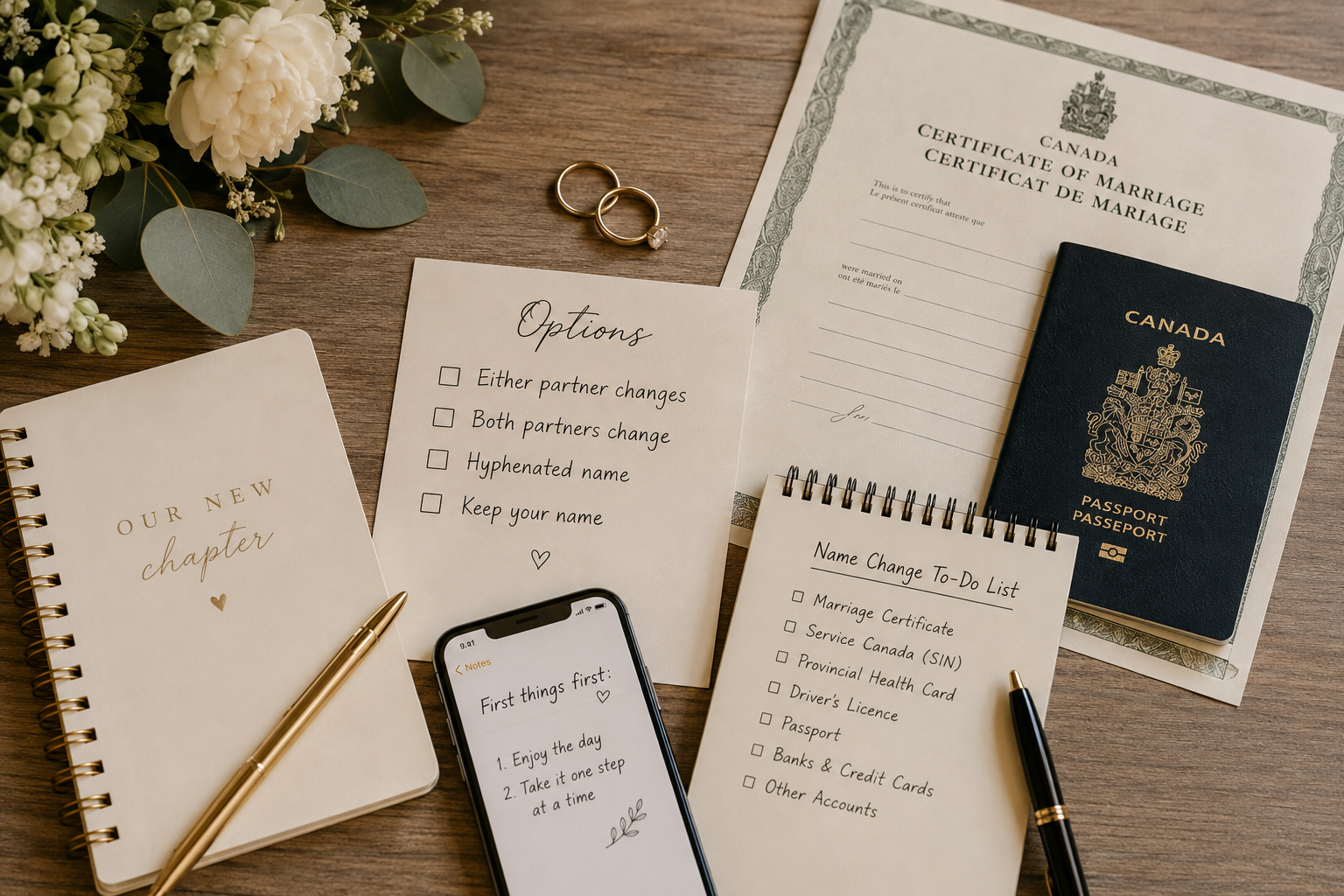
There is no rule in Canada about who changes their name after a wedding.
Either partner can change it. Both can. Neither has to. Plenty of couples choose something in between, such as a hyphenated or combined surname.
The tradition of one partner taking the other's name is exactly that — a tradition, not a legal requirement.
What usually trips couples up isn't the decision itself. It's what comes afterwards: the order of the paperwork, and the fact that name-change rules are provincial rather than federal.
Two different things called a name change
Most provinces distinguish between two paths, and they involve very different amounts of paperwork.
Assuming your spouse's surname
The first option is assuming your spouse's surname.
This is generally not considered a legal name change. Your birth certificate stays the same, and you use your marriage certificate as proof when updating identification and other records.
For many couples, this is what they mean when they say they "changed their name."
It is generally:
Easier to complete
Reversible
Less expensive
Based on your existing marriage certificate
Legally changing your name
The second option is a legal change of name.
This changes your name on the official record and usually involves more paperwork.
Depending on the province, it may include:
An application fee
Identity documents
A criminal record check
Additional supporting documents
A waiting period
Couples often use this route when they want a hyphenated, blended or entirely new surname that isn't simply one partner's existing family name.
If you want to combine both surnames into something completely new, you're usually looking at a formal legal name change.
Budget more time than you think you'll need.
Québec works differently
Québec follows different rules.
After marriage, spouses generally continue using the surname they were given at birth when exercising their civil rights.
That means your legal surname does not automatically change simply because you got married.
Socially, you may still choose to use your spouse's surname in some situations. The important distinction is between everyday use and your official name for legal and civil purposes.
Making the change official requires a formal name-change application, and marriage by itself does not automatically give you the same surname-change options available in many other provinces.
Couples who marry in Québec but live elsewhere can sometimes find this surprising.
If your plans depend on changing your surname, confirm the current requirements with Québec's Directeur de l'état civil before starting the process.
Wait for your marriage certificate
Whichever route you choose, one document usually comes first:
Your official marriage certificate.
This is not the marriage licence you obtained before the wedding, and it is not necessarily the decorative document your officiant signed during the ceremony.
The marriage certificate is the government-issued record confirming that your marriage has been registered.
It usually becomes available after the wedding has been registered with the province or territory.
For most couples, ordering the certificate is the first practical step in the name-change process.
An order that saves rework
The sequence matters more than the speed.
Many organizations will want documentation showing your updated name, and completing things in the right order can save you from having to repeat the same process.
A practical order is:
Marriage certificate
Federal identification, such as your passport and, where applicable, immigration documents
Provincial identification, such as your driver's licence and health card
Canada Revenue Agency
Bank and credit cards
Employer and payroll
Insurance policies
Utilities, memberships and other accounts
You don't necessarily have to follow this exact order for every organization, but starting with your core government identification usually makes everything after it easier.
Think about travel before changing anything
If you have a honeymoon or another trip booked soon after the wedding, pay attention to the name on your travel documents.
The name on your airline ticket should match the identification or passport you'll use for the trip.
That usually leaves you with two sensible options:
Travel under your current name and update your documents afterwards
Complete the name change well before booking travel under the new name
Trying to change everything between the wedding and a honeymoon a few days later can create unnecessary complications.
Update your marital status with the CRA
Your surname and your marital status are two separate things.
Even if neither partner changes their name, you should still update your marital status with the Canada Revenue Agency.
Marriage can affect the calculation of certain benefits and credits, so this update matters regardless of what you decide to do with your names.
If you're not changing names
If both of you are keeping your existing names, the process becomes much simpler.
There is no long list of identification documents to replace simply because you got married.
The important administrative change is your marital status.
You may also want to review things such as:
Beneficiaries
Insurance coverage
Employer benefits
Emergency contacts
Wills or estate documents
Joint banking or financial arrangements
But your surname itself can stay exactly as it was before the wedding.
Keep everything in one place
A name change can stretch across weeks or months and involve a surprising number of organizations.
That's exactly the kind of post-wedding task that becomes difficult to track when some updates are in emails, others are in notes, and the rest are sitting in someone's memory.
MapleVow's Canadian after-wedding checklist helps couples keep track of what has already been completed and what is still outstanding, with province-aware tasks for the paperwork that comes after the celebration.
That way, the administrative side of getting married doesn't quietly become one person's second job.
Requirements, fees and processing times can vary between provinces and change over time, so confirm the current details with your province or territory's vital statistics office and the CRA before submitting your applications.