
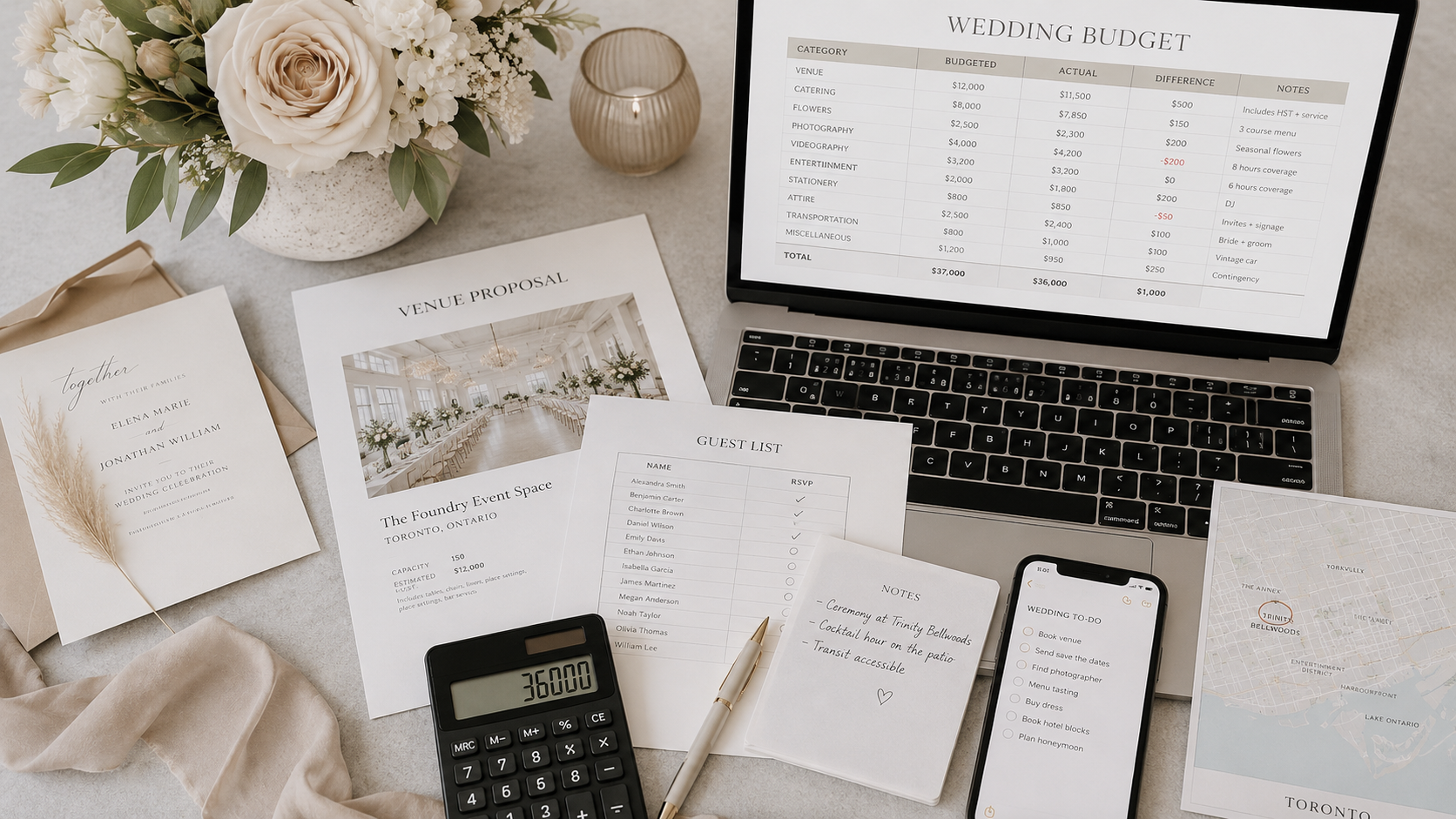
Executive summary If you are planning a Toronto wedding, the fastest way to know whether your budget is realistic is to stop asking for a single “average” and start checking three things instead: guest count, venue model, and whether quoted prices already include service and tax. Toronto has real low-cost options, including city and library venues in the low thousands, but it also has a live market where mainstream banquet halls commonly sit around C$45 to C$150 per person and luxury hotel packages start near C$295 to C$335 per person. On top of that, Ontario’s 13% HST and taxable mandatory service charges can make a quote feel affordable until the final spreadsheet says otherwise.
Full content Why Toronto feels expensive so quickly Toronto is not just “a Canadian wedding, but slightly pricier.” It is a market where the spread between formats is unusually wide. If you rent a public or cultural venue, you can still find site fees in a relatively modest range; Toronto Public Library’s wedding package gallery shows examples from C$2,500 to C$7,500. But the minute you move into full-service banquet or hotel territory, the math changes fast. EventSource’s Toronto banquet-hall listings show real-world price signals from roughly C$45 to C$150 per person for some halls, with Liberty Grand starting at C$110 per person, and Four Seasons Toronto listing packages at C$295 to C$335 per person. That is why two couples can both say they are having a “normal Toronto wedding” and still end up C$25,000 apart.
The “is my budget realistic?” question usually turns on guest count more than aesthetics. Once dinner, bar, service, cake, chairs, stationery, and late changes are tied to headcount, every extra table matters. In current Toronto/GTA planning guides, a 100-guest GTA wedding is often framed as materially above the Canadian benchmark, with recent Canadian planning summaries placing GTA weddings around C$50,000 to C$70,000 for that size versus roughly C$30,000 to C$45,000 nationally. That range is not a law of nature, but it is a useful reality check if you are trying to host a full Saturday evening reception in Toronto with professional vendors across the board.
The line items that do the most damage Food and beverage is still the main budget engine. Toronto/GTA catering directories currently show enormous variance, from modest buffet or casual packages in the C$25 to C$100 range to premium catering at C$150 to C$200 per person or more. Venue-integrated banquet pricing on EventSource often lands between C$60 and C$150 per person in the mid-market, while luxury hotel menus start much higher. If your budget is missing a realistic food-and-bar number, the rest of the spreadsheet will look calmer than it really is.
Photography and video are usually the next reality check. Live Toronto photography pricing pages currently put entry-to-core packages around C$2,500 to C$4,000, with more established professional coverage commonly around C$4,000 to C$6,500 and luxury work above that. Toronto videography guides similarly place many working packages around C$2,500 to C$6,500, with more cinematic and multi-operator coverage running higher. Couples tend to underestimate these categories because social media makes wedding media look standard when it is actually one of the most labor-intensive line items on the sheet.
Florals and design can be either a controlled spend or a budget black hole. Toronto floral pricing is highly sensitive to scope. Transparent market examples currently range from micowedding-style or simplified packages around C$1,999, to florist directories showing many Toronto full-service wedding floral budgets in roughly the C$3,000 to C$12,000 range, with broader GTA listings extending much higher for luxury design. If you are picturing lush aisle meadows, hanging installs, full ceremony repurposing, and dense centrepieces, you are not shopping in the same category as a bouquet-plus-bud-vases wedding.
Entertainment and coordination are also easy to under-budget because couples remember the lowest quote they saw. In Toronto, DJ and MC listings currently start under C$1,000 at the low end, but many established packages sit around C$1,295 to C$3,500. Coordinator and planner pricing shows a similar pattern: month-of or management-style services can begin around C$1,950 to C$2,600, while fuller planning commonly reaches several thousand dollars more. Those are not luxury-only add-ons anymore; they are normal market prices in a busy urban market.
Beauty, cake, and stationery are smaller individually, but together they still move the total. Toronto bridal hair and makeup examples currently range from about C$500 to C$650 for bride hair-and-makeup packages with preview pricing on top, while EventSource listings show many artists in the broader C$120 to C$325 per-person range. For cakes, Toronto listings span from a few hundred dollars for smaller orders to multi-thousand-dollar wedding cakes, with Toronto cake directories showing common entry points around C$300 to C$800 and up. Paper stationery also keeps creeping higher once you add design, printing, envelopes, and postage. Canada Post’s current standard domestic lettermail rates are C$1.24 per stamp in booklets or C$1.44 as a single stamp, so a full invitation-and-reply-card setup can burn through well over C$100 in postage alone before printing costs.
The hidden costs that make couples feel blindsided The most common spreadsheet mistake is treating quoted prices as if they were final prices. Ontario’s HST rate on taxable supplies is 13%, and the CRA says mandatory service charges added to a bill are also taxable. In practical terms, if a venue quotes food and bar before service and HST, the real all-in cost can be roughly a third higher after an 18% service charge and 13% HST are applied to the taxable amount. That does not mean every venue structures invoices the same way, but it does mean you should ask every vendor the same question: “Is this quote before or after service, tax, and admin fees?”
There are also legal and venue-adjacent costs that do not feel expensive in isolation but still belong in the estimator. The City of Toronto charges C$180 for a marriage licence and C$136.85 for a 30-minute wedding chamber rental, room only. If the venue does not include public-performance music rights, small SOCAN and Re:Sound fees can also apply. These are not the line items that ruin the wedding budget, but they are exactly the kind of small official charges couples forget until the end.
How to tell whether your budget is realistic A Toronto budget is usually realistic when the venue and guest count agree with each other. If you want a premium downtown hotel, open bar, strong food, full professional photo/video, ambitious florals, and 120 to 150 guests, then a modest national wedding benchmark will not help you. If, on the other hand, you are open to a public or cultural venue, a restaurant, a Friday or Sunday date, lighter florals, and a smaller guest list, Toronto is still workable without drifting into luxury spending territory. One of the clearest examples of this spread is sitting right in the live listings: a Toronto library package can be a few thousand dollars, while premium Toronto hotel packages start in the high hundreds per guest once the event format changes.
A good self-test is to price the wedding from the inside out rather than from the headline budget down. Start with guest count. Then price venue plus food plus bar. Then add tax and service. Then add the “non-negotiables” you care about: photography, music, attire, beauty, and flowers. If you are already over budget before you get to cake, stationery, transportation, and contingency, the budget is not too small in the abstract; it is too small for that version of the wedding. Keeping track of estimated, quoted, and actually paid amounts separately is one of the easiest ways to stop this from becoming emotional guesswork. Tools like MapleVow already structure budget tracking that way, which is more useful than a single “budget” column once real quotes start arriving.
Where to cut without making the day feel stripped down The highest-leverage savings usually come from changing format, not nickel-and-diming the details. A Friday or Sunday package can be materially cheaper than a premium Saturday package in live Toronto venue listings. A city or cultural venue changes the site-fee equation. Digital RSVP and wedding website tools remove return-postage friction and a chunk of paper-stationery cost. A lighter floral plan can still photograph beautifully if you concentrate the spend where people actually look. In other words: the cheapest wedding is not the one where every line item is hacked down; it is the one where the structure of the event matches the budget from the beginning.