
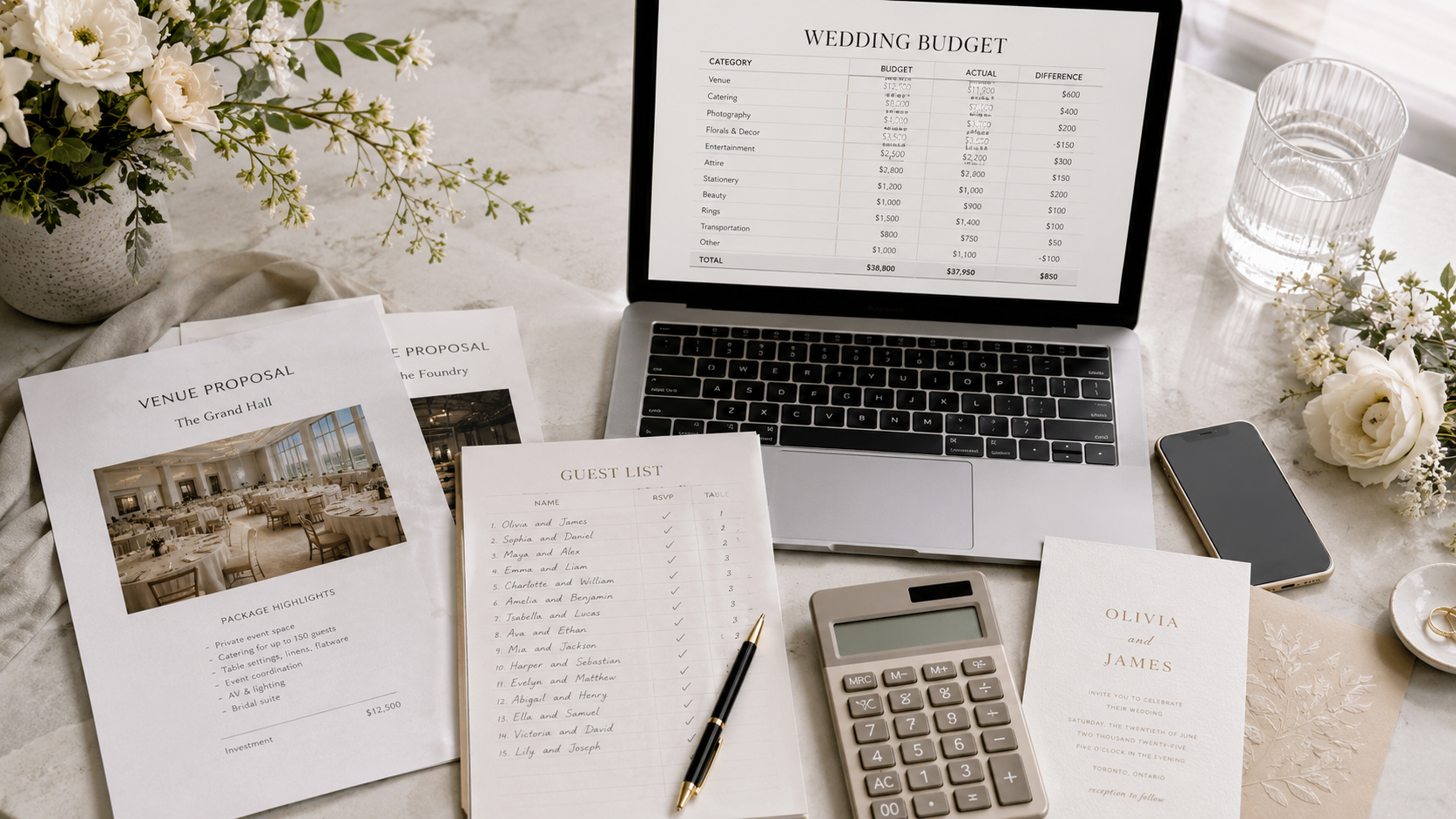
Toronto weddings do get expensive fast. But most couples do not blow past their budget because they suddenly fall in love with ice sculptures or $900 centrepieces. They go over because they make three expensive decisions early — the date, the guest count, and the venue model — before they understand what those choices actually do to the math.
That is also why broad “average wedding cost” numbers are only mildly helpful. A commonly cited Canadian benchmark from WeddingWire put the average wedding at about C$29,450 in 2020, and general inflation has continued since then. Food and restaurant-related prices remained under pressure in early 2026, so a low-$30,000s national benchmark is not unreasonable as a rough planning assumption. But in Toronto, real budgets are set less by national averages than by actual local quotes.
If you are trying to figure out whether a Toronto wedding can land around $25,000 instead of drifting toward $40,000 to $50,000, the most useful question is not “What is the average?” It is: Which early decisions lock me into the expensive version of this wedding?
The expensive version of Toronto usually gets chosen in the first month The fastest way to inflate a Toronto wedding budget is to choose a prime-season Saturday before you have tested alternatives. Venue pricing makes that visible immediately. The Vue’s 2026 prime-season package is listed at $150 per person on Saturdays, $130 on Fridays, and $110 on Sundays, plus HST. Clubhouse EventSpace lists $165/$135/$115 in prime season, also plus HST. None of that requires a complete redesign of the wedding. It is often the same room, same city, same vendor ecosystem — just a different day.
The savings are not theoretical. At The Vue, moving 100 guests from a prime-season Saturday to Friday saves about $2,260 including HST. Moving that same wedding from Saturday to Sunday saves about $4,520 including HST. At Clubhouse, shifting a 125-guest wedding from Saturday to Friday saves about $4,237.50 including HST. That is real money — enough to fund photography, cover part of your floral budget, or simply keep the overall budget from slipping into debt territory.
This is why “keep Saturday no matter what” is not a neutral choice in Toronto. It is a premium choice. For some couples, that premium is worth paying. For others, it quietly eats the room they needed elsewhere.
Guest count is not background noise The other budget lever couples tend to underestimate is the guest list. Once you price real Toronto packages, the person-by-person cost becomes hard to ignore. At Mimico Cruising Club’s advertised all-inclusive package, adding 20 guests is about $2,800. At The Vue’s prime Saturday rate including HST, it is about $3,390. At Clubhouse’s prime Saturday rate including HST, it is about $3,729. At Shangri-La’s classic package once service and HST are applied, 20 guests works out to roughly $6,535.
That means a lot of Toronto budget stress is not coming from dramatic splurges. It is coming from small guest-list decisions that feel socially minor in the moment. “It’s only 10 more people” sounds harmless until you realize it may add several thousand dollars after food, drinks, rentals, stationery, and the knock-on effect of a larger room setup. In practice, many couples are not choosing between a “warm” guest list and a “cold” guest list. They are choosing between a wedding that still feels manageable and one that starts forcing compromises everywhere else.
Venue style matters as much as venue price A lot of couples say they want a Toronto wedding venue, when what they really mean is they want a Toronto-feeling wedding. Those are not always the same thing.
Once you start comparing actual packages, the price gap becomes obvious. Mid-market banquet-style venues and clubs can land around the $140 to $170 per guest range depending on date and inclusions, while hotel and luxury packages can move well beyond that. Shangri-La’s classic package starts at $237 per guest, excluding 22% service/admin and 13% HST, which pushes the effective cost to about $326.73 per guest before any meaningful customization. That does not make hotel weddings bad value. It just means couples need to be honest that they are choosing a different budget category, not simply a prettier room.
The better question early on is not “Do we love the venue?” It is “What pricing model are we signing up for?” A venue with a lower per-person package, relaxed minimums, and fewer mandatory add-ons can do more for your total budget than endless cutting in smaller categories later.
Toronto does not require luxury pricing in every vendor category Toronto vendor pricing is wide, which is good news if you decide early what actually matters to you. Published local listings show photographers with strong starting prices around $2,500 to $3,800, with popular packages around $4,200 to $4,950. Florists commonly advertise expected spends around $3,000 to $7,000. DJs often sit around $1,000 to $2,400 depending on scope and production. Planning ranges widely too, from relatively light coordination to full-service planning at several thousand dollars more.
The point is not that photography should always outrank florals, or that every couple should choose a DJ over a live band. The point is that Toronto punishes couples who try to buy the premium version of everything at once. A more rational approach is to choose two or three categories where quality is visible or lasting, then hold the line elsewhere. For one couple that might be food, photography, and coordinator support. For another, it might be a beautiful room and a simpler floral plan. Budget pressure gets easier once everything is not competing for “top priority” status.
What digital tools actually save This is where a lot of wedding content becomes cheesy. Digital tools are not automatically better because they are digital. They are better when they eliminate a real cost or a real admin problem.
Paper RSVP systems do both. Canada Post’s standard domestic Lettermail price is $1.24 per stamp in booklets or $1.44 as a single stamp, and delivery standards for regular letters are estimates rather than guarantees. If you mail invitations to 100 households and include reply postage, the stamps alone are about $248 to $288 before printing, reply cards, envelopes, or the usual corrections and reprints.
That is why online RSVP is not just a “modern touch.” It removes a real line item and reduces one of the most annoying admin jobs in wedding planning: chasing missing replies while your caterer wants final numbers. The same logic applies to a wedding website. If it replaces printed inserts, accommodation cards, direction cards, and last-minute guest questions, it is not fluff. It is operationally useful.
What a workable $25,000 Toronto wedding usually looks like A $25,000 Toronto wedding is not a fantasy, but it usually involves discipline in the categories that matter most: date, guest count, and venue structure.
It is much more realistic when the couple chooses a Friday or Sunday, keeps the guest list intentionally lean, avoids luxury-hotel pricing, and treats stationery, favours, and highly customized decor as optional rather than essential. It gets harder when the plan includes a prime-season Saturday, a large guest list, premium venue pricing, and a long tail of “small” upgrades that keep getting justified one at a time.
The deeper truth is that the gap between a $25,000 Toronto wedding and a $50,000 one is often not elegance, joy, or guest experience. It is usually the accumulated cost of early structural choices. If couples understand that early enough, they have a real chance to keep the day feeling good without letting the budget run the entire show.