
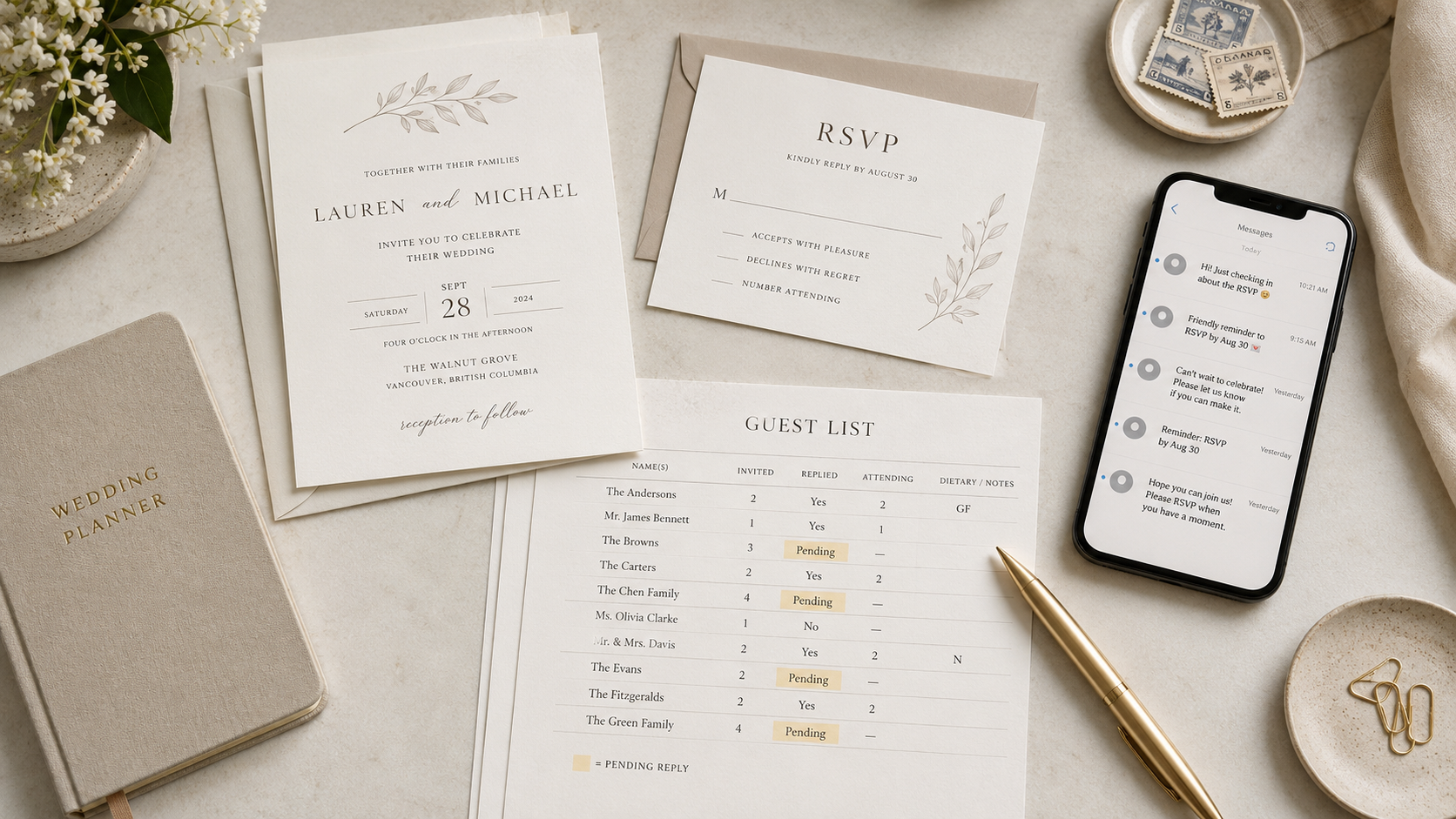
You sent the invitations weeks ago. The RSVP date came and went. And now you’re staring at a list of guests who still haven’t answered.
If that’s where you are, you’re not dealing with some uniquely chaotic guest list. Late RSVPs are common enough that both etiquette experts and major wedding-planning platforms have specific advice for handling them. Guests are supposed to reply promptly and by the date on the invitation, but in real life, that doesn’t always happen.
If you’re collecting RSVPs by mail in Canada, postal timing is part of the problem. Canada Post says regular domestic letters are estimated at 2 business days locally, 3 business days within a province, and 4 business days nationally, excluding the day of mailing, and those standards aren’t guaranteed. In northern and remote destinations, even Registered Mail can run up to 6 to 8 business days. With a paper RSVP, that delay can happen twice: once on the way to your guest and again on the way back to you.
Why guests go quiet Most of the time, guests are not trying to be rude. Sometimes they simply forget. The Knot’s RSVP guidance says some people miss the deadline by accident, and Zola goes even further: late RSVPs are “a part of every wedding.”
Sometimes the delay is logistical. Guests may still be sorting out work schedules, travel arrangements, or whether attending is realistic at all. Wedding-planning guidance regularly points to work obligations, travel costs, and accommodation logistics as reasons guests hesitate, decline, or no-show.
And sometimes the format itself adds friction. The Knot notes that mailing back a paper card is one more step that can stop people from responding, while online RSVPs remove the risk of cards getting lost in the mail.
What to do when the deadline has passed Do not panic the day after the deadline. Wedding-planning sources generally recommend waiting about a week before chasing missing replies, partly because mailed cards may still be in transit and partly because some guests simply need a nudge. The Knot recommends following up about one week after the deadline, while Zola suggests a one- to two-week buffer depending on your timeline.
When you do follow up, make it personal. The Knot recommends a friendly text, email, or phone call to each guest rather than a public reminder or mass blast. The goal is not to shame anyone. It is simply to get a clear answer.
Keep the message short and specific. Couples usually need final numbers for seating, catering, rentals, and meal counts about two weeks before the wedding, so your follow-up should include a real deadline, not “whenever you get a chance.” If someone still cannot give you an answer by then, it is reasonable to treat that as a decline; The Knot notes that if couples cannot track someone down, they may eventually assume that guest is not coming.
A simple message works best:
Hey! We’re finalizing our wedding headcount for June 14. Can you let us know by Thursday whether you’ll be joining us?
If you want to make the follow-up easier on yourselves, split the list between the two of you and contact your own side first. That keeps the outreach personal and makes replies more likely.
How to prevent the problem next time The best fix is not a better chase; it is a better RSVP system.
Set the RSVP deadline earlier than you think you need it. Wedding-planning sources consistently recommend sending invitations about 6 to 8 weeks before the wedding and asking for replies about 3 to 4 weeks before the date, which gives you time to follow up before final counts are due. Put the date on both the invitation and the wedding website so guests have more than one place to see it.
Then send one reminder before the deadline, not just after it. The Knot recommends a gentle reminder about a week before the RSVP date, and a second follow-up one week after if needed.
If you want the smallest possible follow-up list, give guests an online RSVP option even if you still love printed invitations. The Knot says online RSVPs avoid mail-loss issues, while Zola and Joy both offer guest-messaging or reminder tools connected to RSVP tracking. Joy also supports RSVP reminders by email or text, and The Knot provides reminder templates linked to the RSVP page.
The short version: if your RSVP list is a mess, it does not mean your guests do not care. It usually means paper mail, timing, and procrastination all collided at once. Give it a week, send a direct message, ask for a clear answer, and build in a simpler RSVP system for the next round.